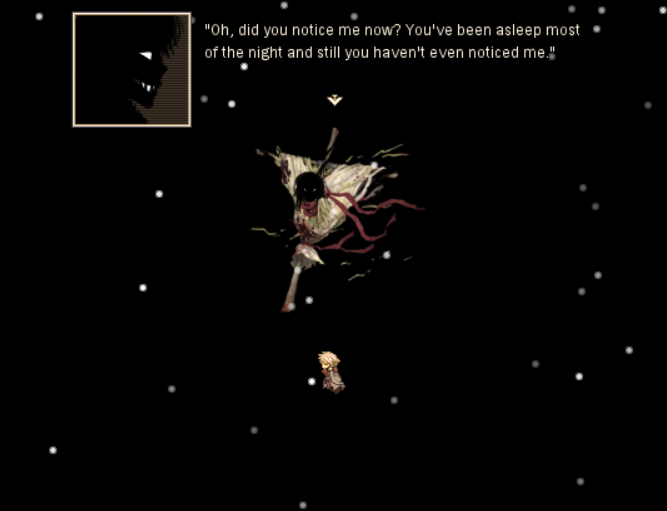
I have a special fondness for RPGMaker games made by one person or small teams, initially inspired by the stellar translation work of vgperson. There is to me strong appeal in the unfiltered and unedited artistic vision of one individual, allowed to be whatever it wants to eb without interference, for good or for ill. These games often have significant flaws, but they can be so unique, outsider art that is not bound by the exhausting expectaions of an artistic industry and is as such free to be something completely different.
My unambiguous favorite is Ronove's gorgeously polished gem Star-Stealing Prince. These one-person RPGMaker projects often end up buggy or unfinished; SSP is a thoroughly, beautifully made game from start to finish. The battle system and gameplay are perfectly fine, nothing groundbreaking for RPGs, but the story is phenomenal. I replay SSP every few years, I always play it all the way through, and I'm always a little sad to leave again.
Every time I do replay it, I think I am going to write something about it. I start but never quite follow through. I think SSP is one of those cases where I love the canon material so much that I don't have a strong enough urge to change anything or explore anything further. The game already explores the character and plot beats I would have and it does that well. I don't even feel the urge to make it gay; SSP is not explicitely queer but the author is a queer individual and SSP has a gently accepting atmosphere (and just a little something something between Snowe and Erio that gets me almost writing sometimes).
As it stands, I can only say that I highly reccomend playing the game. It speaks for itself.
They had said it was for everyone.
Richard’s excuses are thin. He knows that better than anyone. But if you really want to understand—though ‘you’ is no one, a dark room and a chiming clock Richard speaks too from inside his mind as three notes ring in the stone halls of a cold, empty castle—what you have to understand is that they had told him they were going to steal the old King’s paradise for everyone.
Richard imagined… he didn’t know. Shifts. They implied that they would have to take turns, someone serving as an anchor on the ground as the others lived up there. They had said… he had thought that he could do it. He would be the anchor, and everyone else could ascend into the clouds, be wrapped in the bliss of their warmth.
They had… suggested that the boy might be an ideal anchor one day, but that, Richard had assumed, had been a conjecture to be considered seriously once he was an adult.
It would not be an equal arrangement no matter what. There had to be a balance. Richard had been willing to take the brunt of the weight himself. He had thought Edgar understood that. He had thought that was one of those things they just hadn’t talked about out loud.
Like the equally ungainly fact that they had all agreed that the old King didn’t deserve his paradise. He was a bastard, but still. What a thing to say.
--
Meetings with the King, nameless, Richard presumed, as an exercise of both formality and power, a blunt demonstration of the fact that the King was of such lofty position over the rest of them that they must refer to them as child to a father or master, were always unnerving.
Richard didn’t usually come to these meetings, watch standing stock-straight at the wall holding a decanter of brandy like a mere servant (Edgar had told him they had to conform to the King’s antiquate ideas in his presence to keep the peace) but his old friends had specifically requested he come with this time because the King was becoming suspicious of their questioning. Having more bodies there—him and Vera, standing like a reflection on the opposite wall—might suggest to the King that there was no conspiracy against him, no secrets, no plot they found too grim to keep from their common people.
Being made to stand at the wall like human furniture and come at a snap was the least of it. Richard could never be too annoyed by the disrespect because he was occupied with how the presence of the King discomforted him. It always seemed to make no sense once he left again, once there was time and distance put between him and the King’s dim, cluttered, cold tower in the island’s extreme west—Richard could really that he had felt uneasy and disoriented around the King but the exact tenor of the feeling was lost. When it returned, though—
Richard’s teeth set against each other when the King lifted a gloved hand to gesture at him, but it was when he glanced up, a mere moment’s flicker of his eyes, that Richard’s heart jumped into his throat. He hurried forward, frustrated and discontent. Why? There was nothing the aged monarch was doing, nothing in a presumptive gesture or lazy glance that should have him so on edge. But the mere presence of the King made him feel like he was not safe, like he could read an intent to attack through some sense other than sight or hearing, like he could just pick up a note of warning in his voice nearly beyond the range of hearing. Richard’s very body did not want to be near him, but on he went, tipping his decanter to a lead crystal glass clutched in a white-gloved hand.
As he was pouring, the King looked up at him again. Richard’s skin prickled. He focused on the task, on not overfilling the glass, pulling back when there was an adequate amount inside.
“You’re an intelligent man, Richard,” said the King, his quiet, almost whispery voice, always so low that his audience had to lean in to hear him, seeming to drop to Richard’s feet and slither as he spoke, “What do you think? Is it possible?”
Even being put the question put Richard in a bind, because he did not like what he had been hearing for the last minute as the conversation suddenly took a turn to the grim. His impulse was to look up at Vera, still standing a the opposite wall, but he didn’t want to bring the old King’s attention to her, either. He…
Well, he suspected… He gathered… He had noticed that the old man, of course, hadn’t had female company. And he treated servants like furniture. Richard didn’t want to remind him that there was a female ‘servant’ around. That sounded like an absurd precaution, paranoid, and he would not be able to explain it to anyone who was not looking into the King’s red eyes right now as he was, feeling like his life depended on his words.
Why had they taken Vera? He would insist on only men next time.
“I’m no magician,” Richard began, which was true. Like anyone else he had a basic aptitude for magic but not much skill to speak of. Nor was he much of a warrior, much of an artist or inventor—he fancied himself an accountant before anything, frankly. “Following the math as my Lords have laid it out I believe it would work. Though—”
A smile made the King’s eyes crinkle. Richard’s grip on the decanted tightened. “Math!” he interrupted. “Is the logistics of human lives a mathematical equation to you? Can you even out inputting years of life and fractions of the soul and outputting power?”
“No!” said Richard, too fiercely for someone speaking to a liege. Perhaps it had been purposeful bait, because the betrayal of Richard’s sense of disgust in his voice deepened the King’s smile. “No, I meant—in theory, looking at it as though it were just a problem, I believe it would work. The ethical dimension…”
He couldn’t possibly say what he really thought. They had all agreed that the King’s predilections were abhorrent; Edgar had assured him that they were humoring him, sweetening their tongue to draw information from him. Edgar and Lina were both good at playing amiable even to such a disgusting man as the original King; this was why Richard was supposed to stand silently at the wall.
“What about it?” asked the King, still smiling.
“…I would have to think hard on it myself,” Richard fumbled.
“The most joyous rumination,” said the King, his grin curling his eyes now into crescents. “The most delectable part of the process, I think, ruminating over whether it should be done. Don’t think that I don’t consider these things, that I am blind to the harm my experiments could cause. I consider them.”
There was nothing Richard could do to suppress the shudder in his shoulders. “My Lord,” he said weakly.
“Oh, Richard,” said Lina, breezy, light, sounding as thought she was merely tired of the conversation and wanted to switch to a livelier topic, “would you fill mine as well?”
She leaned forward in her chair, extending her glass to him. Turning to her gratefully, Richard smiled.
Edgar shut his wife’s request down with a somewhat uncharacteristic harshness. “Dear,” he said, “you’ve really had enough.”
Line frowned at him. “Oh, really. I’ve had half what you’ve had.”
“I don’t have your condition.”
Lina huffed, but acquiesced. He was right. She did need to show some restraint.
Beyond all odds, and far past their wildest dreams, they had been visited by a miracle; Queen Lina was pregnant.
What is he? The prince moves gloved hands over his heart, and fire spills out between his fingertips. He pulls it like a ribbon, splatters it before him like flicking water off of his fingers. But after the battle as he hands a tonic to her Astra can feel that his fingers are frozen, and feel a shiver in his back transferred down his arm and around the glass of the bottle to her hands.
She knows she remembers him but not well. Magic sparks off of his skin and through the wool of his gloves to ignite once it billows into the air, then spills out where he direct it, snapping the bones of phantoms, sending rats scattering. The burst illuminates the face of a scarecrow looking on from beside the cave wall, leering.
That the fire heals feels natural. If too much time slips away without feeling Snowe’s healing, Astra becomes uneasy in the dark, wet cold of the caverns. The alcohol-burn spikes of warmth from potions or the sparkles of heat of rubbing her gloves together are not the same and do not stay as long. Snowe’s healing fire, crackling on the skin before dissipating beneath, warms her through and keeps her warm—for a while. It drains out like anything else, but while it is in her it is thorough, washed through her from fingertip to noes to toes, like she is immersed in the flame.
One scarecrow bids Snowe to set them on fire with a cackle, but he won’t. It is a difference of substance, of course. What is healing for Astra would surely immolate the man made of straw, even if they ask for it.
Or, Snowe claims that they do. Astra isn’t sure how it is that he knows what the scarecrows are saying and hasn’t yet asked.
Darkness comes from under the doorway. Like a ray of light normally can, visible, piercing. Darkness doesn’t often have the power to do that.
Snowe walked by.
Denial wasn’t even conscious in Snowe. Couldn’t be. He wasn’t aware there was anything to deny. Were the world a vast lake, grey and blue, in the early winter, Snowe would live in the thin ice that skates over the very top, from the first of the frosts.
The demon found a wealth of things to work with in his lower mind, where the metaphorical waters would be, great whales, drowned ships of every size, coral reefs with every sort of life, schools of fish and manta ray, walrus and beluga, sharks and barracuda. Not that Snowe was aware of any of it. But he remembered summer days. He remembered castles and camps and towns. He remembered other kings and villagers. A graveyard, a girl, a guard.
He remembered the damn fires.
The boy hadn’t been born yet at the time of the fires.
Speaking of fires. Where a person’s heart would be in their body, inside Snowe’s soul there was a fire. He was a fire magician. A powerful one. Why shouldn’t he be? Blood of two royal families, each known for their magic, though he wouldn’t have been able to trace a healer in either line if he raised them from the dead and examined them himself. That must be the boy’s own heart. Were anyone else able to see his soul, they would see something must like a star—burning, yes, but burning from inexhaustible source, and impartial to the flames as a stone hearth is, and shedding blossoming, blessing warmth, the desire to help, the attraction to the good, the simpleminded thanks—freely as only the unaware can give.
The demon doesn’t usually have time to regret tearing this host or that host apart from inside their ribs and splattering their heart on the wall. But really. Such sweetness, and treated so harshly. He doesn’t usually have the incentive to hate humans either, but look where he was now.
Literally.
“You should know you have been treated incredibly poorly, and if I were you, I would have slit your father’s throat and taken his kingdom by now,” said the demon to his host one day. “I’m not one to care for what happens to one human or another, since they tend to die before I catch their names, but I do note that you would be a far superior ruler to your arrogant, self-righteous father and neurotic mother. Burn his castle down. My old hosts’ too, for good measure. But then both down while they are asleep, take the girl as your queen, and start constructing a far better kingdom.”
Snowe smiled and batted away an invisible fly from around his left ear. “Nothing, Anastasia,” he said.