Facts
What's it About?
This story began with a sudden need to write about the land of Beleriand and the continent of Endor; I was spending a weekend on a coastal island and thinking about water, fields, and shorelines. Sometimes, I do nothing but watch moving nature. I can do this for hours and hours, and sometimes it is only for my good and sometimes creative endeavors spring from it.
This story also came from my study of Tolkien's languages, and interest in the actual meanings of his words; notes for both canon words and words I invented are thick in this fanfiction. All chapter titles contain direct translatons of the areas the protagonists visits and all invented terms and names stick to the rules of Quenya and/or Sindarin as best I know them.
As for breathing, speaking characters, this story is about the young prince Ereinion, who is not yet called Gil-Galad, being fostered in Barad Eithel by Noldoran Fingolfin. Though Ereinion is attentive to his duties, he keeps being run off-course by his attraction to the reckless crown prince Fingon, whose boundless love of the land and wild behavior almost disguise a deeper insecurity.
Rating
Teen. The most mature thread of this story is an often oblique consideration of the facts of colonial empire. (If you do not consider the Noldor occupation of Endor to be a colonial empire, I suggest you brush up your postcolonial theory.)
Relationships
Unrequited Gil-Galad/Fingon. Gil is Orodreth's son in this one. Gil's crush on Fingon is a hero crush and the feelings of a young man for a much older one.
AO3 link?
You know it.
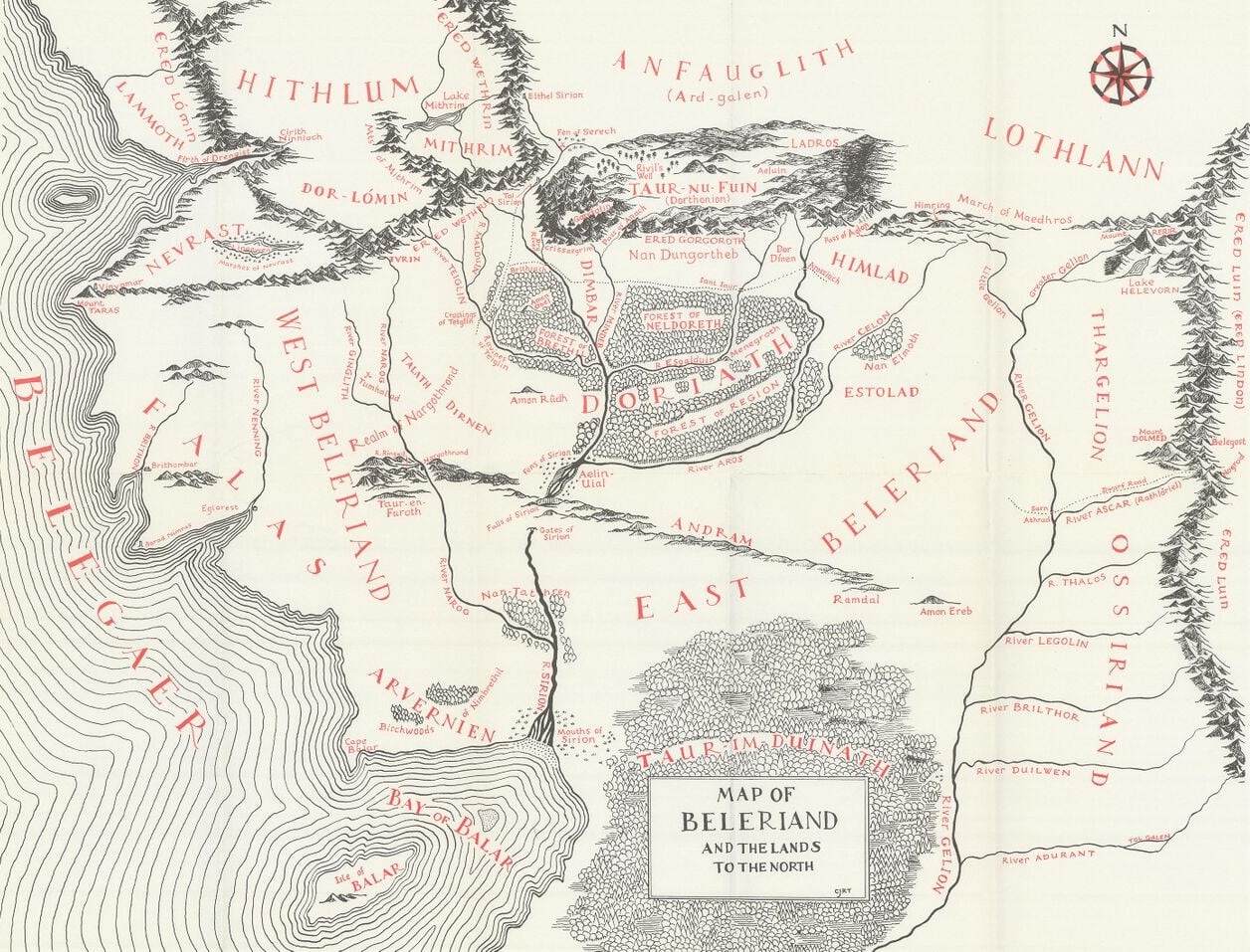
Beleriand and the Lands to the North
I have made Christopher Tolkien's Map of Beleriand and the Lands to the North the background of this page, but will put it here as well for your viewing pleasure.
It is interesting to note that 'Beleriand' was intitally a specific term for a defined region of western Endor, which drifted semantically until it referred to essentially all the lands ruled by the Noldor in exile. One can get much more specific about what part of the land they mean when writing about it.
I will arise and go now, and go to Innisfree,
And a small cabin build there, of clay and wattles made;
Nine bean-rows will I have there, a hive for the honey-bee,
And live alone in the bee-loud glade.
And I shall have some peace there, for peace comes dropping slow,
Dropping from the veils of the morning to where the cricket sings;
There midnight's all a glimmer, and noon a purple glow,
And evening full of the linnet's wings.
I will arise and go now, for always night and day
I hear lake water lapping with low sounds by the shore;
While I stand on the roadway, or on the pavements grey,
I hear it in the deep heart's core.
Innisfree / Faun / Yeats
To the Well of the Great River
“It’s just below; just down the stairs and outside of the door, through the grove, then down the hillside. I cannot believe no one has taken you there,” said the crown prince, bright with excitement, hurrying through the banner-brindled hall so briskly that soon Ereinion was obliged to walk with him just so that he could follow his voice.
“It’s as soft as dew and as gentle as morning here at the head,” he said, strokes of soft light from the high windows of the great hall rising to meet his cheeks, brushing over his head, and slipping from his shoulders like warm sun-showers. “You can take off your shoes and walk across it on bare feet. It’s cold, very cold, but it will barely splash above your ankles. It’s wonderful to walk across so mighty a water on your feet; in the south Sirion roars and crashes such that sometimes even a boat cannot cross. But you know that, you are a son of the river.”
“I do,” Ereinion replied, now following Crown Prince Fingon out of the high-beamed great hall, where he had crossed the prince’s path by chance while looking for a squire. “We journeyed up the river to come here. It was strange to watch it shrink as we went.”
“To great Sirion, you were travelling back in time, from her womanhood to her birth. Her birth is right outside; for a river, that is a perpetual moment, as though the ice is breaking to let the spring rush in every second of every hour of every day.”
Ereinion felt slightly flustered by the prince’s quick words and the rapid thoughts behind them, branching analogies, the revealed roots of concepts shining white in his upbraiding of them. “Can we be gone for so long?” He asked. “I was meant to attend to court today with the King—”
“It is only some hours there, some hours back,” prince Fingon replied, as though his sharp mind simply could not comprehend that those hours would absolutely cause Ereinion to be absent for an obligation that he knew was nearly due. “If you tell them you went to walk across Eithel Sirion they will understand. I will rebuke them for not taking you sooner.”
“Should we take—”
“Some horses? Of course we will. We’re headed to the stable now. I love these northern horses that can gallop across the green all morning and barely grow tired; I won’t make you do it this way, Artin, but I have crossed the pass to Ard-Galen in mere hours, racing the eagles. The golden mares of the Vanyar were lovely to the eyes, but I’d be more likely to eat one than ride one now that I’ve known the beasts of Beleriand. Come, we’ll go out the back.”
So Ereinion followed the crown prince down high stone hallways where attendants carried baskets of freshly washed lovage and fennel greens and bolts of newly-woven gabardine, exclaiming and laughing at him as he skipped past, carrying his father’s ward in his tow like a nervous younger brother. Ereinion was embarrassed already by the pet name—Ar-tin for a little twinkle, a spark, instead of Arta-náro for a noble flame—to be rushing by so many diligently bustling people with barely a hello had his cheeks flushed. But Noldorin princes accomplished much by moving fast and permitting no delay, and in truth his heart was jumping as quickly as his feet as he followed the daring hero through winding ways and odd turns to come suddenly into the blazing light of the sun out of a small wooden door on wrought iron hinges, knocking into laundry as they went.
Since his father Orodreth had sent him out of Tol Sirion to be fostered and taught history and statecraft at Barad Eithel, Ereinion had been officially Noldoran Fingolfin’s ward and student, though he typically only saw the king at dinner or in the evening, where he recited what he had learned from others and thanked the king for correction or elucidation. Though the king was clearly wise and insightful, full of both experience and wisdom, he was clearly tired by the end of the day, and his answers to questions would often into both reminiscence and philosophy, both rich and strange, thick with things to ponder and, on occasion, worry about.
Ereinion saw the bold prince even less often, whose joy, he was told, was to ride through the north and rout the legions of the Enemy; he would be gone for weeks and return filthy and laughing, jingling with bells and shrouded with an air of blood, would bathe and then feast, and dance, and disappear again in the morning. Though his presence was evasive, like a thin, shifting spirit it persisted without his form. Ereinion could hardly go a day without hearing about the prince and his feats, no matter how long he had been gone.
Could he avoid being a legend? The dragon-harrier, the warrior, and the hero who walked the roads of Angband necessarily cast a long shadow from the height of his status. Ereinion had heard that the prince was terrifying in battle, that he screamed like an eagle as he rode across the plane, that it was his touch, nearly, his mere arrival that unstuck the spirits of monsters and beasts from their husks. In the castle, in the stable, at home, the hero was cheerful, energetic, and impulsive; on the night he had met him, the feast that welcomed Orodreth’s son to Barad Eithel, Ereinion had not actual spoken to Prince Fingon until they danced, Fingon drunk, suddenly seizing Ereinion’s arm to pull him into embrace instead of the lady that Ereinion had been dancing with, and he had laughed at Ereinion’s bafflement as heartily as a clever jest. They had shouted conversation as they danced, and somehow in that time Fingon had told him a story of outrunning orcs to their death in a ravine of Ard-Galen, leading them to a chasm he leapt over but they could not; after the dance, Ereinion found himself gasping for air on a balcony ledge, flushed and shaking from the exertion, reveling in the clash of cool clean air and the tremors of excitement that rattled through him. When his heart stopped hammering he returned to the hall and found that in that time, the prince had vanished.
Ereinion hadn’t actually been alone with the oft-absence prince before now, as they both saddled geldings and began their ride out of the castle’s courtyard and into the sprawling groves and gardens that surrounded the keep. Despite that distance Ereinion had grown and guarded an admiration of the heroic prince that now had him in awkward awe of his presence. He had been born and raised in the keep of his father, a Noldorin prince himself, but in Tol Sirion they hid behind the walls from the forces of the Enemy, commanded companies to ride out for them; Ereinion’s father, who was a statesman and strategist, commanded from a war-room, and his mother, who had once been a warrior of the north, was obliged to sit there in safety with him. The crown prince’s insistence on his place in the front felt almost absurd to Ereinion, a trespass of good sense that in its boldness was itself heroic, breaking the bars of a cage.
Prince Fingon had already been wearing riding-leathers when they met in the hall. (Ereinion had been told by servants that it was no laughing matter to get the battle-ready prince into finery to dance or feast, as he hated to be unprepared for action.) The dark, supple armor on the dark prince made him look like night lowering across the fields as he travelled over them, a lapis cloak stretching behind him, broken in spangles by the gold which glittered on his raiment and his hair, and in his eyes, too, which poured out the light of Laurelin onto his cheeks.
Ereinion felt like he was flesh beside Power. Prince Fingon reached up into the branches of an apple tree to pluck her ripest fruit just as he happened to pass below it. Ereinion was then surprised as the prince turned to him and held the fruit out in an open palm.
“I thank you,” said Ereinion, almost fumbling it as he accepted it. He paused before lifting the ripe red fruit all the way to his lips.
“I’ve hardly seen your father since he wed your mother,” the prince said as the grove slowly thinned into fields of vegetable and grain. “Fit to burst, by the way, with both you and your sister; we all laughed at him, since it just wasn’t done by our kind to have children before marriage, but your mother sure straightened out the facts for us. In her head she was married; we were attending a party and that was all. But we just gave the poor man no rest.”
There were those who told him his father was bolder before he had his children; Ereinion could not know that. Now he was just old enough to be permitted to ride up the river, though Finduilas, as a maiden, had no such luck. Ereinion missed his sister much worse than he did his father. “I know it is the Noldorin tradition to have a formal ceremony before a marriage.”
“It is the marriage, or so we would say. We considered that party the wedding, Artin, and would not discuss what happened after, despite it being the true marriage. It was all an imitation of Ainurin marriage, at first, and they don’t have bodies. Your mother’s Sindarin marriage rather shocked us, though that’s not something a son wants to hear, I wager.”
“Then what did everyone do when someone had a lover?” Ereinion asked, as that was the sort of thing his father certainly wouldn’t tell him about golden Aman.
The crown prince plucked a fruit for himself as well, bit into it and swallowed. “Most everyone would try to act as though it was not happening, and disguise the truth if they could. I never liked our squeamishness around it, really. Cowardice. Look; just beyond the far wall you can see the lake shining in the sun, and the river coming out of it.”
Ereinion could see that glimmer on the horizon, but it was not close. The well was large, pouring from high mountainside to deep valley, fed constantly from secret sources under the earth. “It is strange to think that this is the head of the river I’ve always lived along.”
“There’s nothing to see here that you and yours won’t see in mere hours at Tol Sirion; still, the experience of crossing it is worth the while. I’ve seen this river from head to mouth, and every winding curve of the mind in between as its thoughts grow and grow in expression and finally to a roar, but I like the still source best. Come on, we’ll follow the shore.”
Outside of the furthest ring of walls around the castle and its outlying town the grasses on the hillside were wild and golden, rising so high Ereinion could sweep his palm over their soft white heads as they rode. They did not take the road, although it lay close; prince Fingon walked a more direct route through wild thistle and horsetail to reach the lake. Mayflies and beetles burst out of the undergrowth with every step and sang so loud it was hard to speak over them, their endless praise of the autumn sun swelling in verse after verse.
Eventually they broke from the wild meadow to walk along the lakeshore. The spring of Sirion was guarded inside castle walls, but the generosity of the mountain caused it to pool into the Eithel Sirion at its base, where it had carved itself a bed of many miles. The clutching roots of thirsty trees and the perils of eroding soil cut the foliage down to buttercups and clovers and violets on the shoreline. Soft soil pressed under the hooves of their horses; ferns jumped back up in their wake.
They ate all the way, as whenever the crown prince paused in speaking, it was usually to whisk a handful of walnuts or hazelnuts out of a tree or pluck a few ripe raspberries right past their guard of thorns to hand to Ereinion with naught but a smile saved for himself. Then he would pluck wild garlic right up by its leaves, or prize a bristle of pine-needles to chew, or pluck the head of a fern to chew, or pause for just a moment to fish glass-clear water from the lake to drink. Eithel Sirion itself seemed still as a mirror, but when Ereinion dipped his hand in it he felt the silent movement under its surface, its waters creeping up from some deep well under the earth to drift toward a pull they did not understand, which would take them over stone, through roots, down and down, until they became tumbling, frothing, roaring falls of clay and silt.
“The waters of this land astound me,” the crown prince said as they neared the thin, southerly point of the lake, “though the country of my birth had lapis-blue lakes like jewels and star-bright silver streams, they were set in places ordained by the Valar as though set in a crown. They sit in serene splendor, tucked in their glass case. Sirion will eat you like a dragon; she’ll hew the flesh from your bones. Not up here, in her gentle beginning, but down a thousand leagues and a lifetime away where she has become as bitter and fierce as she always will. Her grim fate is set; but it is not. The howling storms of this inestimable land, its grumbling bedrock, even its fearsome inhabitants in the dread north will change its face, and suddenly even mighty Sirion might run another way, and make another nation as she cuts through mountains or decimates plains. Nothing here is timeless; tomorrow, it may change, should sky or sea or earth or Enemy change any of their ever-turning minds. How anyone cannot see that this is a place of incredible hope I do not know. Everything could change tomorrow.”
Ereinion had always lived in that change. He did not always feel like he was sure-footed enough to stay standing on its shifting ground. “You make it sound like you lived in a garden and have broken through the wall to the wilds.”
The prince burst with laughter like a flock of birds taking flight. “You have put it to words! Yes, like a cat who has all along been watching the scuttling of the little beasts outside, and the shifting shadows of branches and fronds and wondered at their genius patterns; some cats come home again for food and comfort, but I would be howling and scratching if one of them tried to put my collar on again. I have told many that I was born in the west but made for this; to the embarrassment of many of my kin, make no mistake.”
“Do you truly feel that way?” asked Ereinion, who had been raised on Orodreth’s stories of the perfection of Valinor, the bliss of that country without sorrow.
The crown prince turned his bright eyes to Ereinion. “Do I really feel that way? I don’t lie for mere conversation. If I were asked to choose again, I would choose Endor each and every time. Do you not see the sun coming down to the far west, how the beginning of her dancing descent will touch the first outer layer of her skirts to the lake, and cover it all with its silken white hue; then an underlayer of pale yellow wine, then shining like pearls and diamonds in yellow, then like cloudberry and strawberry and raspberry in hues of deepening orange and pink and red, the belly of the sweet salmon, the red shine of venison, until all is flashing white again with the fire of her bare flesh, and then the covering curtain of darkness—darkness, Artin, was a luxury the Valar are so jealous of they deprived us of it completely, and I never saw a sky of stars until I made my way to these shores. Darkness is communion direct with the heart of the One, the senses of the body stripped away and the soul remaining, afloat in void. And under the sky—the rifts of the mountains broken by that old Miser in the north to sudden, jagged shapes that rise above the world like the shoulders of watching vultures, the rivers that snake and slither like silver ribbons, the sudden cuts of black ravines, the cloaked emerald depths of the shadowed woods—all of these are blunted into enameled child’s toys by the paternal hands of the Valar in the playpen of the west. Even the rain is not allowed to fall too hard, the thunder to cry its rage and despair in echoes across the plains; Manwe shushes all that passion away, waves off fear with his hand. When I heard a thunderclap for the first time, I screamed like a child, then laughed and laughed. Would I go back to my homeland? My primary motivation in keeping myself alive is assuring that I won’t.”
Ereinion had to ponder the prince’s words in flushed silence. He had nothing to return them with, and disparities to consider when compared to what he knew. Silence befit the last mile of the journey, anyway, as they approached the dip in the earth that heralded the place where the lakeshore was broken and poured out of its southern edge to become a river.
The sun had dipped her feet into the ocean and was now sinking her legs and those red skirts into it with a contented sigh when they drew close enough to see the little stream, twenty feet across, that was all of Sirion’s majesty at her infancy. Because of her saffron light blazed on the water, augmenting but not covering the native silver beneath, which kept leaping out in counter-brightness. The great peaks of the Ered Wethrin threw ever-deepening shadows across the plains of Ard-Galen that stretched unending into a golden, misty distance before them.
A dozen shapes of amber and russet and cornsilk flower grew on the banks. On demounting from his horse, Fingon plucked a stem of three round green leaves framing a cluster of star-like white petals and whispered a name onto it in Quenya. Above their heads an evening thrush was calling out her late-rising song, and the insects of the night were already beginning to rustle and cry in the grass and ferns at the water’s edge. The place between lake and river, otherwise indistinct, was marked by waystones on both sides and a gently curved path of small, smooth stones under the water, like the gate to a city of salmon and perch.
That boundary was made by elven hands. It predated the Noldor—it had to, because it could not be seen by miles away, in fact, one had to be upon it to see it. It did not assault attention from the road, it rewarded the hunter who had searched for it, gone into wild grasses and over gnarled roots to uncover it.
The crown prince breathed out his delight and put the stem of flowers into his hair, tucked between black braid and golden comb. “Here,” he said, and then put himself down into the jade undergrowth, with crickets and march treaders leaping around him, to undo his boots.
Ereinion did the same. Soon they were both barefoot with their trousers pinned up. This made Ereinion aware that the evening had grown chill and he looked at the ice-clear water with some trepidation.
“Don’t be afraid,” said the prince, perhaps knowing, perhaps guessing. He held out one hand and Ereinion took it, and felt that prince Fingon was uncommonly warm. The prince walked backward into the river and Ereinion followed him.
The second the prince felt the cold water on the back of his ankles his face broke into a smile, and he giggled, and Ereinion could not help but laugh himself when he followed forward and felt the cold water on the soles of his feet, then splashing onto his calves. The stones underneath, though smooth, felt sharp and abrupt in the cold; they wobbled onto the water, Fingon backwards, keeping his balance with work and laughter.
Hallway across the river Sirion—as gentle as a lamb who in her nature was as horrible as a dragon in the south—a sudden evening breeze caused the birds and night insects to break into frenzied song, and that swell of sound poured over Ereinion. The sunset had bloomed into full red and the lake blazed beside them on one side. On the other side, it ran away in rushing bursts of crimson and silver and white. He crossed the water hand in hand with Prince Fingon, who led him backward but not astray.
When he reached the opposite side the prince dropped his hand and dashed away, into the first grasses of Ard-Galen, turning in circles until he collapsed on a flower-studded slope, laughing. Ereinion walked to him slower, though no more sober, delighting at the warm earth around his cold feet.
“What a wonder it is, every time!” said prince Fingon from the flowers, which framed his scarred face. “To cross such a great water on foot.”
Dragonflies danced over him and decided he was of no concern. Ereinion sat beside him, the joy breaking into eddies of nervousness as he looked down at the lovely hero, half-dressed and almost animal in the grass. “Did you not cross on your feet before?” he asked, because his father spoke of the ice-march often.
The crown prince, however, lowered his voice and his eyes when he replied, “On ice… not on water. To me, crossing the head of Sirion, like we just did, is a miracle. An act of divine ability. They’re rather small, sometimes. Water. Light. A bird in the air. A beast astray.”
Ereinion’s father insisted they did not have such blessings in this land. Ereinion was speaking now to a man who had enacted them. “Tell me about the birds of Manwe,” he said, suddenly hungry. “About the rescue.”
“Oh,” said the prince, and Ereinion knew he wouldn’t. “Walking Angband, well…”
“Then the dragon,” said Ereinion. He looked to Ard-Galen, limitless at his right hand. “It was in those fields that you chased down the dragon, was it not?”
The smile blossomed again on the prince’s face. “On, the mangy old beast,” he laughed, “The old Bastard’s lizard. Did I chase him across these plains; for hours, with my horse panting under me. Harassing towers, towns, piercing Angrod’s people through their breastplates with a curious tap of his great claws; I had never been more transfixed by starlight or moonlight, by gem or by gold. My eyes traced the blackness of the dragon like my first view of the night sky. I wanted nothing more than to reach him. He little liked my arrows or spears; I endured all those congratulations and thanks while just fuming, petulant as a child, because the dumb beast got away from me, and I barely got a word out of its rumbling throat. I wounded him, I saw the shot of my arrow bury past the armor of its shining neck, but it did not come down. Oh, I was as a mad as a tired babe. Artin,” he said, breaking himself off suddenly, looking into his eyes.
“Yes?”
“I can’t imagine your father has become a devotee of the sword in the past twenty years. Would you like to learn?”
“From you?” asked Ereinion, his face suddenly numb.
“Yes.”
Learn the sword from the dragon-dueler! “Would you?”
Prince Fingon laughed at his excitement. “I’d be delighted! You’ll tire quickly of the respectful solemnity anyone proper dons to teach the art. If you want to learn from someone who loves the sword itself, you can’t do better than me.”
“I accept,” said Ereinion, stunned by the offer. Who was he to the crown prince, another brat sent to his father to finish his education? “When—”
“When it comes—hush. Do you hear the crickets waking up?”
He did, he couldn’t ignore it. What had been loud even before swiftly grew to a cascade of song as red evening mellowed into violet and then black night. Owned by no one, walled by no one, to small to be of concern to anyone, the creatures of darkness lives in tribes of tens of thousands , and their chorus all together, in praise of smaller deities than elves even knew, was so loud it was like it filled Ereinion’s skull when he laid it back into the cool grass, nothing but strains of song between eternity and eternity, land and sky as empty and vast as they were made.
The crossing back over the river in utter darkness, again hand in hand with the crown prince, all things overcome by that wild noise, made Ereinion’s heart beat so hard and his hands tremble so he felt almost like he would leap out from within himself, but he had no clue what he would be without his skin and could not, like the cicada, step out of it and leave it behind.
Notes on Chapter One
Gil-Galad’s confused origin and naming provides the fan author with many choices. I chose, as in previous works, to make him son of Orodreth and a Sinda woman from the north.
In this fic, Sindarin Ereinion (son/scion of kings) is his mother-name, and the name he uses for himself in his narration. His father-name, given by Orodreth, is Quenya Artanáro. Orodreth’s own name starts with Arata, noble, in Quenya (whether you prefer his name was Artaresto, noble endurance, or Artaher, noble lord); the -náro in Artanáro is the same ‘flame’ that ends Feanaro. Altogether, ‘noble flame’, unless you prefer to translate ‘arata’ as high or exalted instead. I have chosen, in this fic, to consider Gil-Galad a later epesse, an adult name that he hasn’t found and/or earned yet. As such he won’t be referred to with it.
People disagree about which of Gil’s names are given by father or mother, which are early or later; whatever, man. In the next chapter, I will be giving Fingon an amilesse, which he does not have at all in canon. Just for fun.
Ereinion/Gil-Galad should, most likely, not be here. Notes suggest he should be a child or youth still when sent away to the havens after the Dagor Bragollach (or how on earth could the young warrior who would eventually wage war against Sauron be sent away by his father?). I instead made him old enough to be studying abroad while Orodreth still lives in Tol Sirion for the purposes of this story. I lean on the ‘fosterage’ system that is found in several pre-modern European societies, in which high-born sons were sent away to relations as young men to be educated, strengthen otherwise distant family ties, ensure the nobility remained connected and entrenched, and make valuable social connections that would help them rule in the future.
Barad Eithel is literally ‘the tower of the well’, and Eithel Sirion is ‘the well of the great river.’ My description of Eithel Sirion was heavily inspired by Elk Lake, the headwaters of the Mississippi. It also has a man-made boundary, lined with smooth stones, that a person can walk across; unfortunately, that crossing has a rather ugly history of being destroyed and remade for commercial reasons. That does not stop it from being beautiful, or the moment of walking over the Mississippi from being wonderful in a way I tried to put my finger on here.
The source of this story was wanting to write about Endor. Everything else came after that urge. You’ll see I listed her as the main character in the tags. She is, though the action is stuck to the characters that can move and speak.
To Mist and Darkness
On dewy dawns, through dusks starting ever earlier, while autumnal breezes plucked dying leaves and hurried them away to their hidden resting places, the prince made good on his word to teach Ereinion the sword.
Ereinion’s father had been rather reluctant to teach or even order the teaching of that art. He had instead learned the Sindarin spear from his mother and from her former sisters-in-arms, cheerful common women who maintained a laughing and boisterous watch of Tol Sirion’s walls, often making teasing sport of their ostensible allies among Prince Orodreth’s guard. The Noldorin host with their cold armor and sword-cut faces would swiftly call the prince away from those spearwomen if they ever caught sight of him behind their woven cloaks and chastise him for mingling with them. Whether that was because they were women, or fighting women, or even Sindarin women was usually unclear. It wasn’t his place, they said; which place they had made for him among them, however, he could not find.
That was the past; Price Fingon gladly taught Ereinion any art of war or sport or rough survival he wanted to learn, though when it was that Fingon would suddenly appear to toss a sword or bow at him was as unpredictable as the attack of an orc. Ereinion had told the High King as much, which had made the serious old lord laugh.
In future days, in a later Age, in Ereinion’s memory Fingolfin Noldoran was always reclined in his sitting room, a comfortable dark and private room in the highest tower of Barad Eithel with velvet curtains drawn across the leaden windows and a low fire spreading the perfume of smoldering cloves and orange peels. Aran Onnaedh (that was, King Seven-Scars, as he would be called after his death) would seat himself in a silk-upholstered chair beneath a great tapestry of the streets of Tirion upon Tuna; the metallic threads lining the cobblestones of the street and the glass of the streetlamps would catch the gleaming of the sparks of the fire as they flew and burst in the air. He always had a wool blanket on his lap, a cup of tea with dwarven liquor dribbled into it in his ring-covered hand, a distant look on his face that meandered, wandered into the distance, found castles and falls a thousand miles away in the stone of his walls; those talks were slow, Ereinion recounting all he had learned in the day and the High King providing corrections or additions, in his slow, low, considering voice. Often he even reconsidered his own points, stopped, criticized himself, as gently as though he were his own patient father, and then set himself aright with a new teaching, which Ereinion could not help but commit to memory. King Fingolfin’s long years and deep learning were cut like ravines in his mind, so rich with lore he often spoke in rhyme or meter without meaning to. He infused his lessons on statecraft and diplomacy, mere logistics and household management as well as the arts of justice and discernment, with the legends of elder years, told in the old tongue, mixed with verses from days gone by, learned from the lips of Ulmo or Manwe.
(Many years later, there were those who wondered how that patient, firm, nurturing King could so suddenly and viciously choose violent death, putting his body against the Enemy Himself. Ereinion, however, could so easily see that hero within the quiet and soft-spoken man he recalled from that smoky sitting room that he did not wonder at it. That man had considered all opportunities, considered and re-considered, labored over plans for the future like a tapestry-weaver; when he reached his final conclusion, all he had left to do was to stand up and enact it, and he did so with divine certainty. True and thorough consideration of the facts, though it makes one slow to act, does not in the end hinder action. It makes one seize at the correct action with a certainty and conviction and unmitigated will that not men nor Valar nor thunder nor the rending of the earth can dissuade. Besides, Ereinion had known his son well, and could see the similarities between them.)
He chuckled warmly when Ereinion recounted to him that he had started learning the art of battle, too, but that his lesson times were erratic, his teacher moreso, and he never knew when or what it was he would learn, though he certainly did learn.
“That is my boy’s way,” said the High King, fond and soft. “One must avoid ever needing Fingon. You do not find him, he finds you.”
Ereinion questioned the wisdom of this gentle permission; it was a very sensible leave to extend to an errant hero, which Prince Fingon certainly was, but perhaps not to a crown prince training to be king. The thought, however, of not having Fingolfin Noldoran as High King, who cowed the most bellicose and grumbling of his subjects without raising his voice above a murmur, was so hair-raising that no one liked to think seriously about it or about anyone being king after him.
Besides that, Ereinion’s irregular appointments with Prince Fingon’s flashing blades were so thrilling he did not have it in himself either or protest their form or timing. He would go to his balcony to watch the white winter dawn climb the jagged black horizon; he would see the prince below, sharpening a sword, and the sharp glint of his eye would rise from the ground to strike Ereinion backward. Once he rushed down the stairs to find Prince Fingon having retreated to the grove and almost out of the castle walls; after that, he found it in himself to leap over the side of his balcony instead, to rush down the roofs below him to Fingon’s laughter below.
The crown prince was stunning in swordplay. He slowed down the arcs and thrusts of his sword so that Ereinion could learn them, but even so diminished they shamed the wings of birds and the legs of dancers in their grace and perfection. The crown prince could turn aside every one of Ereinion’s attempted strikes while moving in circles as slow and deliberate as the moon turning around the earth, as if his opponent’s movements were orchestrated by the hand of Eru and he had the divine sight to trace them in time and respond like he was merely intercepting the ordained fall of a leaf in his hand.
When Ereinion begged prince Fingon to speed up and show him what he could really do, he found his heart in his throat every time. The prince’s spirited attack came with the unbroken gaze of his shining eyes, the glimmer of the tips of his teeth in a smile. Ereinion would be light-headed after, grinning, unable to think about anything else or return his mind to his studies.
He knew he was a young man, as so many kept reminding him; he was not therefore stupid. He tempered his giddiness and excitement on his face to prevent the prince from recognizing them.
(He sometimes overheard—could not help but overhear—sometimes exasperated and sometimes giggling comments about the crown prince’s amorous past. They would say—well—one way in which Ereinion’s Noldorin kin differed from his Sindarin is that they found quite a scandal in love between men or between women. (Many thought the latter wasn’t real.) Ereinion once walked into a wall after overhearing a particularly pointed hiss about the prince’s preferences—he tried to put it and similar insinuations from his mind.)
He thus found himself quite anxious to pack and ready himself for the trip with the crown prince to the country of Hithlum.
They had been up in the early morning—in the night, in fact, because Ereinion had been woken by a sudden noise and had found the crown prince unsleeping, and together they had gone out to hunt what Fingon said was surely a wolf howling. They never found it, but then they ended up sitting beside each other on the cliff under the walls of the castle, watching a witching-hour fog creep over the valleys below, and then the prince began to speak about the fields and marshes of Hithlum, about the mists that ever rolled like another sea above her shores.
“I spent my first years in this land there, in those perpetual mists, under the sun that seemed to always be thin with cloud,” he said, “and though so many of the people who came with me were miserable in that cold and damp place, to me it was like always being in the dim anticipation that paces behind the curtains of a stage, in a formless place behind the scripted poetry and properties, hearing the drama of manners from behind it, knowing what was fated to happen and yet unable to shake from myself the growing, arousing sense that I could with a tug of the curtains separating this world and the next change the future of both. And when the sea breezes did manage to come all the way from the west, to break up the perpetual mist and show us the golden glory of Hithlum unveiled…”
Prince Fingon broke his speech and looked at Ereinion. “Have you ever been to Hithlum?”
“I have not,” said Ereinion.
This trip would take more men and horses and packing and planning. Though the High King ruled that land and the Noldor farmed and formed it, it was said that fell foes stalked the silent, dark mists around their scattered settlements, drifting in with the fog through the Ered Wethrin, or even from Ered Lomin and the bitter Helcaraxe beyond. But the crown prince had a quite devoted retinue that would follow him into the pits of the Enemy (some were quite aggrieved he hadn’t taken them the first time) and going on a trip with the King’s young ward was certainly acceptable to them.
They set out in the early morning, meaning to cross the pass over the Ered Wethrin in the first day and camp on the other side at night. Though the pass was used often and was the best way through that steep and jagged range, constantly growing as the shorelands and midlands pushed on each other, it was only the best of bad options; they climbed its steep side on switchbacks in the morning, crossed over high mountain bridges that trembled over arrow-quick steams with the noon sun on their backs, and finally began clambering down the other side while day was waning. The prince did mention, though only once, that he could have taken it in two hours at a gallop alone; Ereinion could laugh a little at his boasting now, though it may well have been true, and the prince laughed with him as he did.
The very peaks of Ered Wethrin were greenless, white and violet and black shelves of stone that cut through each other, riven with the scars of divine war, but below them the slopes that looked sparse from the ground were alive up close. Green grasses and blue wildflowers climbed high up the sides, speckling and then vanishing as they climbed; oak and hickory became cypress and juniper and then spruce and fir over spreading carpets of needles, which too scattered until only lavender brush and jade moss and white lichen grew on the stones of the mountain. Birds sang all the way up and down, from gently piping wrens in the blackberry bushes below to the calls of falcons on the heights. There was never a moment, no matter how austere the view or how cold the air became, that Endor silenced her song. It became slow, and haunting, and stunning in the heights, single voices that echoed and reverberated, and were answered from mountains away. Until the very tips Ereinion was surprised by fleeting sights of hoof and horn and brindle fur, quick shining snaps of snakes’ tails and wax-white fish in the streams.
As they crossed the high winding pass that led them between two peaks, prince Fingon laughed, “The mountains of shadow are not living up to their name in this bright winter sun.”
There were moments when the sharp edge of a cliff or peak cast foreboding darkness over the pass, but Ereinion had to agree; the white winter sun in between was so bright it radiated into those darknesses. “My father told me he crossed these mountains many times. They were more unpleasant in his descriptions.”
“He did, and oft by himself; our arguments aggravated him and he would remove himself from us. It was no more dangerous than what everyone else was doing for a moment of peace. And yes, they usually are. This is a bright day for Ered Wethrin. It's the cold coming on.”
The new-born winter nipped at their necks as they rode. “It clears the clouds.”
“Sometimes, we all have a day against the meaning of our names,” said the crown prince with a smile. “I must forgive them.”
“When our names demand so much,” said Ereinion, “sometimes, we must.”
He saw prince Fingon’s sideways glance at him and felt a flush at the back of his neck. “Even the mewer, the cat, is silent sometimes. There’s a reason we have two, at least.”
“I feel—sometimes—too small for my names,” Ereinion admitted.
“Do you? Too young yet, maybe. Naming an infant Artanáro is asking a lot of the babe, but you’re not expected to have a fiery spirit while still drinking mother’s milk.”
“Not that one,” Ereinion replied, “though I do sometimes wonder what ‘flame of nobility’ is asking from me. It is my amilesse I feel I fall short of.”
“What was it?”
“Ereinion.”
The prince chuckled, not a mean-spirited chuckle. “In the new tongue.”
“Her tongue.”
“Scion of kings—she isn’t of Thingol’s line?”
“‘A glae’, she always names herself; ‘from the grass’. She means ‘from no one’.”
“What kings did she mean in ‘Ereinion’?”
“Finwe and Olwe, and Ingwe through Queen Indis.”
“The three.”
“My mother told me,” Ereinion replied the prince, now flushed, “That in naming me, she recognized that which was in me but was not in her. To you and those in the High King’s castle the fact that I come from these lines is commonplace. It was my uncle Finrod who was the first scion of all three. To her, it is a wonder, and a mystery about me. I am—not like her. Not from the grass, but the stars, the heavens; the West. I’m not supposed to be Sindarin like she is. I’ve noticed.”
The crown prince looked up to the sky where, above all the peaks of Ered Wethrin, a single golden eagle paced on silent hunt. “We reckon that a man is of the people of his father and his paternal line,” he replied after a moment of thought. “Or else a man like your uncle Finrod might claim every throne he wishes and have a good argument for each. Not that he would.”
“I am not primarily concerned with thrones. I am concerned with whether I am of my mother’s people. I protest that I am.”
“To most, such a claim would be a denial on your part to the other side of your family and any status of a prince’s place among them.”
“Because to claim the low is to reject the high; odd, to me, because I believe the high must stand upon something. And yet she names me Ereinion,” he mused, not happy with prince Fingon’s answers, not totally unhappy, and watching the eagle disappear into a cavernous shadows, “not of one king but of many. Each are lofty to her, and bound in a name together and equal.”
“The name your mother gives you is a serious matter,” the prince replied, “but its meaning will come to you in time. Do not worry about being too small for your names. It is not yet time to fret about becoming a lord or a prince or a king or what those titles mean. You have to become yourself first. Chasing lordliness before you know yourself is reaching for a cloak without having a body; even if you grasp it, it will benefit you not.
“This is one reason I must call you Artin,” he continued, his cheerful eyes now as quick to flash as a turning coin. “Artanáro Ereinion is just too much, as of yet. Don’t worry about it, little spark.”
Ereinion replied, “Fingon is not the name your mother gave you, is it?”
The prince laughed sharply. “Fingon is not the name anyone gave me! My father named me Findekano; fin originally from finwa, clever, skilled, dexterous, not finde, hair, I insist, though I admit the words are related through delicate and fine; and cáno is commander, or herald, though I know my father meant commander. That was not a name I fit at your age either. But there is no difference whether I say it in Quenya or in Sindarin, the name is the name, and it is mine. It is our mothers that are credited with foresight, but my father who was right.”
“What did your mother name you?”
The prince did not reply right away. His eyes searched the heights; nothing else appeared, not bird or beast, not fog or mist. The sun cut through all and left them on the tip of the world, Eithel Sirion behind them, glittering but silent from afar, and in the distance, to the west, perhaps the silver glimmer on the horizon was Mithrim, their quest.
“My mothers were Vanyar,” the crown prince said, referring in dual to his mother and grandmother, “and my mother the Lady Anaire gave me a name in an old tongue, one she learned from her fathers, predating the assimilation of that Vanyarin dialect into the King’s Quenya. It is Purmanturo; in proper Quenya, Ruinduro.”
“Fire…”
“Queller. Blaze-lowerer. Fire-queller. Purma is the same as ruine, red fire, earthly fire. One who stifles a blaze. She told me that when she hunted her heart for the name of her firstborn son, there came to her a vision of a great red fire, a perfect circle of fire, which was sinking into a black sea, and was quenched by it until it was no longer alight. She took this to be my name. Though she did not understand the vision, she could describe it.”
“But she saw a sunset, did she not?”
“I now believe she did, but my name predates the sun. She did not know what she was seeing. If she had she might have named me Andúne, or Andúnero, to make it more of a fitting name. To put it in the language of this land,” he said, and paused, though clearly he had considered this translation in depth before, “Annûnor, I believe.”
“Fingon Annûnor,” Ereinion repeated, and it tingled as it left his lips, like it imparted its warmth upon them.
“Sun-setter?” Fingon asked, looking to his distant namesake, white in the heat of the day. “Day-ender, even? I don’t know what she saw, and worry myself that I still have not grown into that name; if she had only seen me quelling the fire of some furious beast I would be content.” He shook off his momentary discontent with another jingling laugh. “As it stands, Fingon I am and remain. My favorite is my earned name, anyway; may you earn many yourself in time.”
“Astaldo,” said Ereinion, nearly as delighted with it himself. “Valiant; earned from quelling the fire of the dragon, so you get your desired name anyway.”
“Oh, no, no; I was called Astaldo before that.”
“From your rescue of King Maedhros.”
“Yes—well, no. No. Yet before that.”
“From what?”
The prince looked into the black valleys below them, now opening as they crossed over the high pass and into the descent awaiting on the other side.
“Well,” he finally said, “it became a true name after the rescue, in any case, and everyone started using it then, when it was but a few before.”
Ereinion was not certain what he meant, and the suddenly lowering of the crown prince’s tone made him hesitate before he questioned him. Had some deed in the blessed land, the haven of Valar, earned him the name Valiant One long before the sun?
If so, why did he look so unhappy to remember it?
“Ereinion,” the prince said suddenly, just as the shadow of the mountain they had just crossed began to creep up from behind them and reclaim Ered Wethrin’s name, “it can be simply son of kings, not scion, as you are also a son of mighty Sirion, born on her banks, a son of Endor, whereon you were laid once born, and a son of the Sindar, in the arms that held you. To have a history is not a demand, necessarily, that one repeats it. A very many good things come from good kings that are not more kings.”
“You too, Purmanturo, can be a son of the Vanyar,” said Ereinion, “if you like, and in secret, if it will cause problems for you otherwise.”
The prince was not bothered by Ereinion’s gentle offer, but neither did he accept it. “That is one thing I never was, Artin; you see no gentle happy Vanyar here in this excellent land. They continue to ponder the motes of dust in the sun where ever they did and will in quietly aging halls. Restless Noldor surround you; none more restless than I, desperate to track every mile of this land I can, and hungry for more the minute I swallow another. I will be delighted to see Hithlum again; hold me back from going yet further to places unknown, I have duties to attend to and I know it.”
—
They camped one night at the base of the mountain, where cold, wet air, gathered from the clouds, had grown over the long years a high dense forest, then crossed into Hithlum. Another silver river would lead them at length to Mithrim if they followed its bank west, but prince Fingon insisted on crossing it on a fine King’s bridge and then going north.
They travelled some hours through slowly creeping fogs, which were at first thin but seemed to gradually gather in layers, like watered ink laid over and over itself on canvas, lingering then over swamps that widened between vine-draped groves and thin patches of reeds. At length they found an old stone road, with mosses growing over its cobbles and ferns between them, marked by a waystone that was only plain shale standing on its side, sunk into the marsh around it.
“This was the first road,” the prince told Ereinion, “and not many use it any more. Make no mistake, this land is well-settled, and towns are farms of both Noldor and the old Hithlum Sindar lay all about us, but I am taking the way into the old north, where it is harder to convince the cold, wet land to yield good fruit.”
“Are we not going to Lake Mithrim?” Ereinion asked.
“Oh, yes; we’ll go there on the way back. It’s well worth seeing, that mirror-like lake, that obsidian-faced beauty; but now settlements ring around all its shores, with walls and watchtowers. It’ll be a prince’s visit when we get there and we’ll have no peace. For now, Hithlum—Hithlum of mist and darkness, of crowing crane and egret, of hissing serpent, croaking bullfrog, calling cicada, gathered reed and darting dragonfly; Hithlum as I remember her, in heathen bliss, teeming with life and grandeur that needs no elven eye to witness it or elven touch to thrive.”
Ereinion recognized the prince’s odd cues for silence now (they were heralded by his uneven, spontaneous poetry), and as bidden let his mind wander around the marshes as they rode north in silence, let the focus of his hearing shift from shrill insects in discordant choirs to reed-birds cackling at each other to early owls mumbling in the branches overhead, and to how those oaks and cypresses, cottonwoods and hazels rustled as quietly as swinging skirts in the slight drift of the mist. Their old wood would crack and those cracks would resonate across the still waters, over their heads; light grew dim, and the syrupy sunlight that did drip through the gathered banks of fog was dispersed everywhere, as if contained within the leaves itself, the dew on the leaves, the scales on the backs of slow-moving, spine-lined fish.
The old road snaked around rivers and lakes, sometimes barely above water, sometimes grown over, only appearing as grey stones beneath clutching cypress roots. Tall-stemmed spear-like wildflowers, with thin petals of violet and saffron and citron, grew in almost obstinate clutches on riverbanks, and the branches of the trees glimmered with tribes of insects whose iridescent wings shone like faceted jewels as they waved in the wind together.
The waters, however, were the wonder of old Hithlum. Flowing slowly as a cold serpent, they were as thick and dark as the dregs of red wine, mixed with golden and copper veins of silt and soil and sparkling ore, abundant with fish that were tiny and shimmering white or monstrous and gleaming green or draconic golden predators twice larger than an elf and swimming with the grace of queens. Their surfaces danced with water insects, black beetles and silver darters, and the ruby-winged dragonflies and jade spiders that preyed on them. The harmony of life in those waters, once Ereinion cloud hear it under the clicking of the horses’ hooves and the copper clanking of their bells, sang a low, slow song, rippling water and the fins of fish, yellow reeds tapping on each other, the buzzing winding spiral flights of the multitude, a verse that took all day and night to sing and would be sung again in the morning.
They made camp in a nearly-dry grove of swamp oaks early; early for a field or forest, that was, but not early for shaded Hithlum. Evening dropped darkness on the marshes like eyelids shuttering; it seemed like deep grey turned into utter blackness in mere minutes. Veils between earth and sky had slowly thickened during the day; now, under the double weight of cloud and fog, Varda’s lights were completely concealed. There was no help from the heavens when it came to setting up rugs and tents and fires for their evening meal. The darkness was as total as Ereinion had ever seen, and the sounds of the swamp seemed to ring in that darkness, rushing water and croaking frog and calling owl, rising around him; and prince Fingon’s tree-golden eyes were like those of a cat.
Then the stars on earth began to shine.
Spark-flies. Sithin. He had heard of them. The world became Elbereth’s sacred shine. Wordless themselves, without cry or call, the sithin gathered in silent, contemplative penitence, and then did the work of Valar with the minds of flies.
“Here, see,” whispered Fingon, and a flash of starlight from a sithin lit the curves of his palm. He curled his skillful fingers around the bug, which then flashed between fore and middle, quickly and again, light seeping from the curves of his hand.
Ereinion laughed. When the prince moved to take his hand, he whispered, “No,” because he had no will to catch one himself. But the prince was not directing Ereinion in the hunt, he was gifting the sithin, now crawling curiously on his finger, into Ereinion’s hand. It walked on with a patter like raindrops and then it glowed.
Ereinion watched the starlight kindle and die and kindle again in his hand until it flew away.
“Just like you, Artin,” said prince Fingon with a laugh, “a little spark.”
The thought of a spark that did not progress to fire, but sparked and sparked, lit and relit, shed only light, no heat, flashed in Ereinion’s head in a way he did not understand and made his heart flutter in his mouth. What was it? That the light was innocent, and did not burn? That it was made by such a humble creature? That it gathered in forsaken Hithlum, land of mist and darkness where no man wished to dwell? That it came and went, and came and went, and never went away forever?
—
Mist and darkness rolled on like ocean billows for two more days, and they met again the range of Ered Wethrin in the north, where though they were the same kin as their southern sisters they did not feel the same. Life was sparser on their sides and did not gather on their peaks. Beyond, though distantly, almost as if they were a trick of the eye, a mirage duplication, Ereinion thought he could see more mountains, far away.
They stopped at a place where an ice-white river cut through the peaks high above and made a pass, though a poor one, into the lands beyond; Ard-Galen, though in its westernmost extent.
The crown prince said nothing as he stopped at the pass, unmarked, unnamed, and perilous, but he stopped, and watched.
After some time, Ereinion said, “That is not the Ered Engrin I see beyond?”
His stomach sank when the prince did not, at first, respond. Eventually, he said, “I was curious to see if I could find it a second time. I saw it once but never again, because I did not come back the way I came. Here I passed out of Hithlum, then into Morgoth’s country—here Ard-Galen is His country, fruitless, merely a strip of wasteland between Ered Wethrin and Ered Engrin, which you do see beyond, risen by the Foe in ages past. From here I could retrace my way in, perhaps.”
“But we will not,” said Ereinion.
The prince did not immediately reply “No, we will not.” It was his only reply before he took the reins of his horse again, and began to lead them onto a trail that went slowly south.
Ereinion found himself less willing to ask for details of heroic deeds with the Iron Mountains over his shoulders, just close enough for the eye to see, but feeling close enough to breathe hot breath on his neck. Heroism is a stand against despair; despair is its mother, and it remains unborn without her. Without a dragon, all are only men; being crushed in her jaws reforms someone, eventually, into the bent and jagged shape of heroism.
Ereinion wondered if it was truly love of a friend that drove someone to take the first step up that mountain pass and into the homeland of death. He recalled, now, in the lessons of history his father taught him, that his heroic cousin the crown prince had gone into Thangorodrim for two reasons, by his reckoning; love of a friend, and to heal the rift between the Noldor and make them one kingdom. One family.
To see one High King on the throne, over one land. Such a deadly voyage was made not in ignorance of danger but in fear that the consequences of inaction would be even worse; not courage but desperation, scrambling gasping and panicked out of the rift of division that had torn brothers apart. Not calculation—no cold calculation could ever lead a reasonable man into such incredible peril—but sheer fear, or scorching, unquenchable love, or both in burning mixture.
Astaldo the hero spent his days sprinting into danger with joy in his heart. In nights alone, in days idle, in companionless silence, what ran through him in place of that joy?
Lake Mithrim, as the crown prince had promised, was beautiful but densely peopled. It was hard to find a moment alone in the crowd and the carousing, but Ereinion would catch glimpses of the midnight-black lake through windows, over balconies, in moments so startling it almost struck fear into him, like catching a glimpse of an unearthly beautiful man in an alley or in a corner and being rattled by his presence. The still waters doubled or tripled the city above it, made its lanterns and lit towers into spears of light which swung and circled around. The mirror was too fine, like perfectly polished silver; it glittered so brightly it softened details, and it was hard to see the reflection of the stars under the city lights. But they were there, deep in the dark waters, like sunken jewels. The black surface itself, when it could be seen under the light, was as rich as velvet, and the shining crown prince, gold in his black hair and tree-light in his dark face, was all but lost to Ereinion until they left Mithrim again, encircled in constellations of admirers.
Notes on Chapter Two
I like a Vanya Anaire, though Noldo Anaire is more likely to be latest and most correct canon. Still, with these elven mothers, Tolkien gives us so little I feel a bit of freedom in imagining them my own way.
To make Fingon’s ‘Vanyarin’ amilesse, I used Quenya terms from older versions of the language that Tolkien eventually changed or abandoned. ‘Purma’ appears to be a version of ‘blaze’ that ‘ruine’ eventually replaced. (They specifically mean red fire, earthly fire, as opposed to heavenly flame, but as stated the name predates the sun and Anaire wasn’t sure what she was trying to name.) Ruinduro should be standard late Quenya, both are ‘blaze’ plus some version of ‘undu’, a root-word meaning ‘sink, lower, go under’. The various -ro and -or endings are agental suffixes, word-endings that imply the person who has this name is the person who does the action described. Whether it translates as blaze-lowerer, fire-queller, sun-setter, or even day-ender is up to interpretation.
Andúne (to Andúnero) is Quenya for sunset, literally sun-sink or sun-down (anar ‘sun’ plus the same ‘undu’ root), and Annûn (to Annûnor) is the same in Sindarin.
‘Aran Onnaedh’ was just me having a bit of fun giving Fingolfin a post-mortem epesse in Sindarin. ‘Odo’ is seven, ‘naedh’ is ‘wound’, ‘d’ and ‘n’ can turn into a heavy ‘nn’ when mushed together into Aran Onnaedh, King Seven-Scars; a reference to the seven wounds he dealt Morgoth before dying. I was at first hesitant about putting a double consonant before a diphthong as Quenya doesn’t like it, but I can find several examples of the same in Sindarin (like ‘pennoediad’, uncountable), so I believe it is fine.
‘Sithin’, spark-fly, does contain the same ‘tin’ from Artin, a word-root taken from words meaning spark or kindle. It typically remains ‘tin’ in Sindarin instead of morphing into ‘thin’, but I was combining it with ‘sitha’, an old Gnomish root for insect, found in word like ‘sithaling’ for dragonfly. While the strong ‘tin’ would normally remain as-is, Sindarin prefers to soften words over time, so I think in this case the gentle ‘th’ would take over the strong ‘t’. I cannot find any way to pluralize sithin within the rules of Sindarin (‘i’s do not morph, back-up ending plural -in is literally already the end of the word), so, like some other i-heavy Sindarin nouns, I kept the singular and plural identical. If this were written in Sindarin the article would indicate the number.
For extra fun, I do have a Quenya term for them as well, singular ‘tinipi’ or plural ‘tinipir’, with the same root ‘tin’ in Quenya, and ‘pi’ meaning fly (bug. Fly as a verb is vil-).
Lightning-bugs/fireflies prefer hot or warm climates and really shouldn’t be in Hithlum as I wrote it… maybe it’s seasonal. Or maybe Beleriand bugs are built different.
As much of the description in chapter one was inspired by Elk Lake, much of the description here was inspired by various wetlands and swamps in the southeast of the union.
Notes Ahead of Chapter Three
They are about to be discussed, but in this chapter I invented and named two holidays, a holiday from Aman called Minyalostie, and one from Endor called Ylonnath. Ylonnath is transparently based on Imbolc, Minyalostie does not have a direct analogue, though spring flower festivals of a sort are prevalent where I am.
‘Minyalostie’ is ‘first-flowering’, quite literally. Often minya (first) reduces to min- in a combined word, which I wanted to do here, but since loste (bloom, verb) starts with a consonant that will not combine with ‘n’ in Quenya, I had to keep a vowel between them. -ie makes the verb a gerund, blooming, and so, first-flowering. I considered both Minalostie and Minyalotie as slight variations, but in the end stuck to the long form.
‘Ylonnath’ was a little more experimental. There is no agreed-upon origin of the word Imbolc; some think it’s ‘in the belly’, referring to the lambs about to be born, some think it comes from the word ‘milk’ or even that it has something to do with spring cleansing. The associations with perhaps lambing or perhaps milking are strongest and have connections with holiday traditions and lore. An old Gnomish (pre-Sindarin) word for lamb is ‘iol’ which Strack advises using as Sindarin ‘Yl’. ‘Onna’ is the Sindarin verb ‘beget’, and -ath is a shortening of -athon, the future tense ending. I wanted the Sindarin word for Imbolc to clearly be a word that had been sanded down with time and use, so I compressed lamb-begetting into Ylonnath, as good a translation as any. My Sindarin is not as strong as my Quenya, but I believe Ylenneth is if not a perfectly accurate pluralization it is at least not embarrassingly wrong.
As I named Ylonnath for Imbolc, I cheekily named the one Avar woman I named after Brigid; Brigid likely means ‘exalted one’ and Khalla is old Gnomish for lofty, exalted. The ending is general but comes specifically from maite, skilled, again an old form that did not make it to late Sindarin or Quenya.
To the Green Region
A cold winter kept Barad Eithel inside a coat of ice for two long months. The trip to Hithlum was the last time Ereinion ventured outside the castle grounds for quite some time.
They passed the winter merrily anyway, with pods of clove and pepper and anise crackling on fires and stewing in pots of steaming mead or wine, with dances and feasts in the fir-wreathed great hall, afternoons winding through the hedge-labyrinth garden, red with holly and green with ivy. Ereinion was fortunate to spend more time with the high king, who was as bound to the weather as anyone else, and much time too in the king’s vast library, where he polished his Quenya and his history and learned quite an amount of metallurgy and mathematics and music. The days of studying, rather than wearying him, had him sometimes restless; in velvet-dark winter nights, he awoke from dreams that did not seem to come from his mind, hallways and stairways and valleys and hills he had never seen, faces that felt familiar but for which he had no name.
He had not expected to gain sight or visions, which preferred women and often waited for age, nor was he precisely sure that true visions they were. If not, then what? Futures unravelled not from his wisdom but his wants, or mere amalgamations of imagining? There were in those dreams those unknown who called him ‘cousin’, and ‘brother’, and they spoke of kinship with all, cautioning always hospitality for the stranger, in wooden houses on wide shores, in stone mansions carved into mountain-heart, in halls nestled in valleys green.
Some time after the visit to Hithlum, as snow was piling on the roofs of the palace and the sound of Eithel Sirion outside had been silenced by ice, Ereinion found himself stopped in a dark hall by one of the crown prince’s men.
The prince had a retinue of warriors, as they were so often brought to battle. This man was one akin, a bright-eyed child of Aman missing his ears and bearing blade-marks on his face.
“Yondo Artaresto,” he called him, and Ereinion replied alike in proper Quenya.
The warrior regarded Ereinion with an expression of discontent. “How long does the prince your father intend to have you dwell in the high king’s halls?”
These warriors were not curt and dismissive for no reason. Ereinion tried to give them grace. “He would have me stay for five years, half the time a man was sent away for fosterage in his youth in Aman. Five years in Beleriand, he says, is as long as ten in Valinor or longer.”
“Indeed it can be,” replied the warrior, “I had years in Aman that now I cannot recall one moment of, for I did nothing but enjoy them.”
Uncertain how to reply, Ereinion asked, “Is there some reason I should not remain here?”
“Nothing that matters to me,” he replied. “Only I would say to you, young man, to be careful how you go.”
“What do you mean?”
The warrior bluntly replied, “Disguise the lust in your eyes when you look at Prince Astaldo. If you cannot, or wish to pretend it’s not there, then lower them in his presence.”
Ereinion felt as if stung by a wasp. His breath halted and would not let him deny the charge. If he could speak, he would argue with ‘maile’, lust; he had done no crime and had no desire in his mind to commit one. He had come to the conclusion quite young—he and his sister in conversation—that one did not pin a charge of murder on someone who merely hated, and likewise, it was not right to pin the crime of perversion on someone who merely longed. No crime had been committed, and a person’s mind was not a realm subject to a king or his punishments.
The warrior laughed at his expression, a laugh neither mirthful nor mocking, but bitter and short. “You are a guest in his father’s house. Think on that. I tell you also that though the prince is not married, he is neither free to love. His hand is laid already in another’s, and besides that hand he always grasps a crown; he cannot extend an empty palm. No matter which gauntlet you grasp, there is always something inside.”
“I don’t know what you mean,” Ereinion told him, and he didn’t, at least not all of it. But the warrior let laughter follow his enigmatic words and left without any more.
—
Spring came eventually, as ever it does, and as ever the animals knew first. Birds sang louder and sooner, deer poked thin legs through patches of snow and sniffed the quickening soil beneath, and the lambs and cattle rose and prepared themselves to make their matches and their families. Like washing-women or farmers they got to work while ice still gripped the waters and were already out in the cold and about their business when the bell-tolls of Eithel Sirion breaking open ran down over the valleys and mirror-still lake.
It was barely spring but spring indeed when the crown prince invited Ereinion to ride with him over melting drifts to a town in Ard-Galen, where they would celebrate “a real Ylonnath; far be it from me to tell you what a real Ylonnath is, but I far prefer the rustic celebration of the season over the frigid garden walk my father will host.”
In Aman their people had celebrated a holiday in the spring called the first-flowering, the Minyalostie, which was celebrated on the first day that petals unfurled from stem on the smallest and whitest flowers of the vale, the snowdrops and spring bells, whenever it was that day came. Ereinion had celebrated Minyalostie all his life, for although it was humble is was one of this father’s favorite holidays, and it was at fun for children, too, finally let free to run around in fields after the cramped darkness of winter, to make bracelets of buds to gift to each other, and to dance in honor of Vana, Lady of the Spring.
Some among the exiles had, however, stopped celebrating Minyalostie, or stopped celebrating it of itself. It came often a mere week before the holiday of Ylonnath, celebrated by both Sindar and Avari, named for and in honor of the sheep. Lambing, it meant, or lamb-begetting, and it was celebrated after the first birth of a lamb. Ylonnath, too, Ereinion had celebrated in his childhood, though not in garden parties or at festivals but in kitchens and barns. He watched the lambs be born and struggle to their feet while drinking the first milk of the spring, hot and honied, then listening to his mother’s sisters-in-arms talk into the night around a warm hearth about the days of their own youth, before the Enemy in the North had set His armies on the march, before the Noldor came in ships, before the sun, in the endless trackless dark world where the fur and breath of animals kept a traveller warm in the night and the wolves would let you ride on their backs, knuckles in their coarse fur, if you shared the sacrifice of a lamb with them.
Many had since combined the day of flowers and the day of animals into one holiday that celebrated the season, rather than stretching the food stored over winter into two feasts sat perilously on thinning ice and tenuous promises of milk and fruit. Others kept to one or the other; Ereinion could not be surprised that prince Fingon had discarded Minyalostie for Ylonnath, nor that he would abandon his father’s table for a ‘rustic’ one in a northern town. Unable to resist, Ereinion saddled his horse and followed the galloping prince across fields of melting snow and pale green.
It took the full day to travel to the town prince Fingon wanted to visit, and in his fashion it wasn’t until they had stopped to eat and let the horses drink from a glass-like stream of melted snow, after hours of riding, that the prince admitted he had never been to this town before, but he had heard about it from farms nearby as a place that kept ‘old ways’ and it was next on his list for a visit. It was far to go, and when they arrived, they had to beg the guard at the gate to let them in out of the dark and into whatever home would host them.
Ereinion was surprised to find it was a town of Avari, mostly, who seldom settled so far west (or indeed settled at all), but they were mixed with many Sindar spouses and children and companions. Conversation around firelight that evening informed them that the Avari here had been once people of the far north, people of the ice, finally forced to flee the Enemy when He set his Umaiar to destroy their homes and enslave them. Many had been captured or killed, but the survivors had resettled as close as they dared to their own homeland and, eventually, mingled with the Sindar native to Ard-Galen. They spoke an insular Avarin language among themselves that sounded to Ereinion’s ears like galloping hooves but were happy to speak in Sindarin with the visitors, and they spoke long into the night, answer all of prince Fingon’s eager questions about the bitter-cold but white-shining northern shore they had come from, where the surrounding sea was frozen over in the winter, over which they crossed to islands that laid just under the northern star, where they danced in the ruins, they believed, of stones that fell from the Walls of Night, black and sharp and glistening with outer starlight.
They happily accepted an invitation to celebrate Ylonnath with the town the next day; they expected a lamb would be born in the morning. That night, Ereinion and prince Fingon slept together on a wooden floor wrapped in wolf-furs, listening to the hissing and giggling of excited children who couldn’t sleep on the night before the holiday. Ereinion, wondering how old he was himself, had to hiss and shush the prince a few times, who was both an incurable chatterer and a poor sleeper.
He couldn’t sleep either. The point of the arrangement was to share warmth; through wolf-fur he felt the prince’s sides rise and fall, was warmed by the heat of a soul that burned bright.
—
Everyone had been fairly certain Ylonnath would come overnight, but raucous cries still rang out across the town when it was announced during breakfast that one of Khallaite’s sheep was ready to deliver.
The strangers were excluded from most of the ceremony, but this was because typically children performed it. Adults watched from outside, shouting encouragement, as the youth of the town rushed about inside the barn, helping two animal mothers through their pains. When they were both done they took the mothers and the newborns outside into the field to take their first steps on the wide earth, under the sun. The midday feast was taken right there in the grass, with winter’s store and spring greens laid on the wooden boards together.
All the rest of the day passed in revelry and Ereinion quite agreed with prince Fingon’s assessment that Minyalostie at Barad Eithel could not have possibly been so raucous. A spirit of drunken joy rushed the day along like white river galloping over gray stones until it suddenly came to a strange and sudden stop, an uncannily silent pool, when just after dark all celebration ceased and the young elves stood up again. They gathered the milk of the sheep in a goblet, and took another that was empty with them, a child with the milk and a youth with the empty goblet. They returned to the barn and all the people followed them. Then, setting mothers and children aside, the children walked among the old sheep until they selected an aging ram. Then they all went to the gates and Ereinion saw a blood sacrifice for the first time.
The old ram was put to sleep as gently as rocking a babe. The other goblet was filled with his blood and his body was carried outside, where it was placed beyond the gate. Then milk and blood were poured at the gateposts, and, after a silence of voices filled with the song of owls and wild dogs, the people went in, the gates were shut, and celebration began again.
Prince Fingon stayed with Ereinion by the gate as he gathered himself, stuck between the cold wind of the outside and the shouts and cheer from inside the gathering-hall. No Ylonnath he had ever been to had such a celebration; he had heard that Avari did such things, but dismissed those claims as ignorant.
“It’s for the Enemy, they believe,” the prince whispered consolingly, “for His evil maiar who roam the land, and the wolves and vultures He has stolen to His service. It’s a simple bargain; they leave something for those wicked ones to sate their hunger in hopes of being left alone themselves. It’s symbolic; it’s done by the children. No one is so stupid they think this will really satisfy the Enemy. A wolf will take it. Some say it’s from older times still, when it really was an effective way to ward off monsters and fallen maiar by appeasing them; it was really an old creature, Artin. That was what I meant, actually, when I said I wanted to see a real Ylonnath—I suppose I should have warned you.”
“I’ve seen plenty of Ylenneth. That’s not…”
“They practice it the Avarin way, I suppose.”
“They give to the Enemy.”
“It’s not for the Enemy, Artin. It’s to ward Him away. They’re on our side. You know, you sound just like your father right now.”
“What does that mean?”
“It means you’re stubbornly missing the point. This is for the children; for the young they hope to raise strong. They were tasked with making a choice themselves, a hard choice—you saw they had to choose the sacrifice, and they chose as well and as fairly as they could—and now they believe that by making this sacrifice they have kept the whole town safe. I love your father, but I know he would have kept you and your sister in a nest of down feathers in a golden cage if he could, to save his own heart from the fear of what might happen to you. It does not serve you. Children raised in gold and gems lash out at the destitute as if they are enemies, frightened by their suffering; princes who know no need become tyrants. That’s why I pushed him to have you fostered.
“Come on; you’re only so sick because you’re so drunk. Let’s go inside again. We’ll get some rest and then celebrate Minyalostie in Ard-Galen tomorrow.”
—
It was long after they rode back out of the town gate in the morning that it occurred to Ereinion that he had indeed seen no ram at the gates, and its body had been taken in the night. What had accepted the sacrifice none would ever know.
Before he thought of that he was thinking of the fresh wind blowing from the east, sweet with the scent of grass, sour with the scent of melting snow, rich with the scent of wet soil, and quick and flying yet faster through the day. He and the prince journeyed into the south, darting like dragonflies down a transient spring stream, a ribbon of glass-clear water flowing over waving grass.
They meant to find the hills of Ladros, the heather-covered and ivy-tressed highlands, but between where they were and there were nations of wildflowers, seas of spring green in every direction, rising rapidly out of winter as they ran to the south. First snowdrops and croci lifted white and blue and lavender out of the wet grass, then violets like velvet and clovers like cotton, then phlox and woodruff in white beds beneath, trillium and trefoil perched modestly atop; blush-pink sorrel, wine-red milkweed, sky-blue gentian, thistle and flax all rose like spears from the green as though their horses raced through the season, as if they travelled out of the year and into eternal spring, onto the island in the sky where Eru kept the flowers safe all through the storms and frosts of and seasons of Arda.
The streams appeared and disappeared and the snowbanks shrank under the golden spring sun. The prince’s whoops of laughter became at length silent, simmering joy, a grin that never left his face as sweat beaded on his forehead and on the flanks of his horse. Groves of walnut or pear trees appeared here and there, but the horizon of Ard-Galen was featureless, endless green in all directions, spring-green, jade-green, brightened by the spilled jewels of the earth, petals of every color, buzzing with honeybee and butterfly.
Ard-Galen, though a possession of the High King and open for settlement, was hard to farm; they saw no other towns in their wild ride south. Deer leapt and wild horses thundered; crow and magpie called. The wild wheat and millet already pushed golden needles through the green, and untamed it would grow higher than a man in that boundless, sorrowless sea. Ard-Galen in the spring was a place that had never known a harsh touch, had never had a single one of its thousands of thousands of white blooms plucked, had never seen a man with its eyes.
They came at length to a river established, cut into the green land by the years until it had gentle bands carpeted in ferns and violets, sedge and marigold, horsetail and meadowsweet, soft plants that parted like curtains when Ereinion swung off of his horse and knelt at the banks to drink for the clear water.
When the prince, laughing, sunk down into that soft riverbank, back on the earth and eyes to the heavens, Ereinion did the same. Sun-yellow mayflies and small white butterflies swarmed over them and away; the horses mingled and grazed.
The prince closed his eyes and Ereinion watched him burrow his back into the comfort of the earth. Even at rest Ereinion could see the strength of his arm, of his chest, settled like a storm dwelling inside gathering cloud. Ereinion thought about how some spoke of the prince, as a wolf or bear in the castle, always pacing the floor, gnawing at the bars; he thought too about the night before, shedding blood to assuage, deter, to bargain with the Enemy. He thought of the heroic deeds that this quietly dozing man evaded discussing; dueling dragons, rescuing kings, slaying monsters. Was it mere humility that kept him from bragging about his works? His mood fell when he discussed them, like one might when admitting to the shames of youth. Yet he always went into the next battle singing, the next fight laughing, as delighted to shed blood again as he was reticent to discuss it after.
Ereinion wondered if he was looking at that Noldorin squeamishness he was always told he himself lacked, which was a charming terror about anything that acknowledged the living body. Both sex and birth they shrank from, healing they hid and limbs and hair they covered fastidiously; the shedding of blood seemed to count as another thing to be ashamed of for some of them but not all. Yet he could not imagine that prince Fingon was modestly embarrassed about his heroism, not when he eschewed so many other norms and fears of his folk; and he seemed not just to understand the sacrifice of the lamb but to approve of it. To delight in it, like a hawk or a crow invited to the feast of hounds, a communion transcending tribe.
“My prince,” said Ereinion, and the prince interrupted him.
“You cannot call me by my name? We are kin, even if we’re not especially close kin.”
“You are my elder.”
“And your lord, and so forth. I’ve also held your hair while you spent your dinner. Having had your refuse, may I have your friendship?”
Ereinion flushed, but the prince’s eyes were closed. “Your logic is indisputable.”
“It is, but I understand your reticence to dispute a nonsensical argument.”
“Fingon.”
“Yes.”
“You are so rarely at the feasts and celebrations of your own people, even when they mean to honor you,” Ereinion began. “You rush all about the map to empty places and little towns and gatherings of the fish or sithin. At first I assumed you were merely restless and needed to roam, to work instead of staying idle. Now I wonder if you think of it all another way.”
“Consider that, perhaps, I don’t think about it at all, but simply go forward in life with the intelligence and intent of a buzzing bumblebee.”
“I think you intend to be a prince, that is, a servant of all Endor, in the way that Ainur are servants of the world,” continued Ereinion. “And that you intend, in the way of none other of your kin that I can think of, to be the servant of Noldor and Sindar and Avari, of men and dwarves, of bird and beast, of tree and flower and stone, and to protect each equally from the Enemy of all, and to that purpose you dwell among all of them without preference to one.”
Fingon responded after a silence. “To consider lordship to be servitude is the way of the best of lords,” he agreed. “I could never quite manage to be so selfless. That sounds fantastic when you say it, but I am in truth driven by my heart. I want to be with the trees and lakes and the Sindar and Men and monsters, though the monsters always manage to make such meetings unpleasant. If while I enjoy them I also serve them, that is a fortunate coincidence.”
“You want to be among monsters as well?”
“Have you met an orc, Artin?”
“I have not.”
Fingon opened his eyes to the sky. “I can almost understand them speaking, now,” he said, “I am starting to understand words in their tongue. To speak is to be a child of the One, or else all my understanding of the world is mistaken. To speak is to think, to desire, to fear, to love. One day, Artin, I will get one of them to speak to me.”
After a moment to think, Ereinion said, “You have slain them by the hundred.”
“I imagine it will be a fraught conversation.”
“You slay them believing they are children of Eru?”
“They rather force the hand, in my experience.”
“But—”
“The dragon, too, spoke; it hissed a curse at me as it flew away, and bellowed at those it harried in the green. I know they think, they speak to each other, tell their stories and honor deeds of valor, teach their children and must, even if all they do is turn their back on the corpse, must nonetheless choose in the moment to turn their backs on their dead. Could one sit around their fire, could one at least listen? Could a moment of feeling between monsters be witnessed? Children of the Enemy do not get out of being children of the One, because His paternity is still followed through His irascible eldest son. I cannot imagine what straightening they will endure or how painful it will be once they meet with Namo, or Nienna, or whoever waits for them. Do I serve them in sending them on? If slaughter is service, we come to conclusions about servitude and lordship I do not like or fully understand. Yet the more I slaughter, the more eager all are to elevate me to lead them. I can’t imagine I will lead them to anything but the same.”
“Is that how you think of yourself?”
“Following the heart and its joys does not lead most people to bloodshed as it does me,” said Fingon, watching as the little creatures of the air, the butterfly and beetle, danced about each other in the breeze. “I do understand that."
Ereinion paused to consider Fingon’s words. They seemed so bleak, yet he could not square them to Fingon’s typical certainty and confidence. If he thought his path was one that led to doom, he would not walk it so boldly or with such passion. “I have little love for our enemies, since I hate what they have done,” he said, “and I cannot imagine loving them as you do, but I do not think that you should let having such a virtue spoil your own love for yourself.”
“Artin!” Fingon exclaimed, turning his face in the grass to face him.
“You could use my name as well.”
Fingon smiled. “Artanáro.”
Ereinion had no way to hide his flush, though fortunately the squirming in his stomach stayed underneath his skin. “Yes.”
“Were you really born of Artaresto? So many of our faults did not come down to you.”
“My father has his faults, but he is a good man.”
“So he is.”
“His caution and concern are sometimes overbearing, but they are still not flaws. My sister, perhaps, would give you a different judgement on them, but I maintain he means well. His rigidity and love of rules are also vexing but not vices; he cares about proper behavior and treatment of others and does not abide less. If by flaws—”
“I mean the self-deception, Artanáro,” said Fingon, “the lies and the bickering and fear of judgement above all other things; the scramble always to find who is to blame rather than to look inside. You are so ready to think and think twice, and to find the reason behind the actions of those around you. Had any of us had that skill in Aman, perhaps we would not have exiled ourselves from it. Instead we made friends into enemies and never once considered their side of the matter, stupidly accepting the least charitable explanations, offered by the least thoughtful people, just for the joy of slander and hate, just for the addict rush of self-righteousness. The birds are less likely to quarrel and the fish less likely to devour each other than we were; I’ve seen unnatural behavior. Your kin will tell you that trying to love your fellow man, he of another nation or kindred, is strange and suspicious; you, Artanáro, were born with a heart unbent by that twisting. The deceit it takes, both self-deception and the founding lies of a whole society, to kill other kindreds and not grieve them, is something I hope to forget understanding. I did grieve. I do. I was a creature confined in the land of my birth, not by smaller mountains or gentler seas but by childish people stunted by bliss, raging at polite slights with no understanding of real harm. In that bliss I became the worst of petty princes and you should be thankful you will never know him. Here only in black-soiled Beleriand am I broken open into something better, like this bright violet from its bud. And I will not be even to orc or balrog or dragon what I was…
“If asked,” Fingon continued, suddenly interrupting himself, “what it is I think of your father, I would laugh, and say he was a good man, though his paranoia and his adherence to authority are both charming. I wonder, though, what he said to you about me?”
Ereinion had hoped he wouldn’t ask. He thought before that Fingon never worried about what others thought of him. He saw now that it was not so. “He said that you are someone who will kill your own.”
Fingon smiled, as softly and fondly as if Ereinion had told him that his father responded with glowing praise. “May he never forgive me.”
“I—”
“It is hard not to harm my own, now, as I forget who is or is not my own.”
“I do not always think as my father thinks.”
“Nor I. What do you think of me, Artanáro?”
Ereinion breathed out with a sharp though silent gasp, and his words stuck in his throat. He could not think at all; Fingon was watching him so softly, like he spoke to a little lamb. He told himself that he must think of something to say but he didn’t.
“I won’t be offended if you do think the same of me,” said Fingon. “I’m never offended by the truth.”
That made Ereinion’s throat tighten and his chest pang with pain. He could not endure Fingon thinking he hated him or was disgusted by him. Nor did the suggestion that Fingon thought Ereinion would lie through his disgust and feign friendship through his hatred have no sting. Did Fingon really think he was so dishonest or deceitful? Had he done anything at all to warrant that?
Ereinion was thus prodded by the stabs in his heart as he flinched forward, both into and away from the pain. He still had no words in his mind at all when he reached a hand toward Fingon and then put it on his face. His gold eyes opened into stars; Ereinion covered him on the grass and then kissed his lips.
He had been kissed by mother and sister and father and friend, and none of those touches had felt like that one, warm sweat-salted Fingon under his palms. His hands trembled and his heart was aflame. When Fingon made a noise beneath him, a sudden exclamation he could feel on his teeth, he forgot himself and pressed the beautiful prince beneath him.
Then Fingon put a hand firmly on his shoulder and pushed against him. Erenion went, braced on the grass on both sides of the man below him, and he saw immediately in Fingon’s eyes that he had made a mistake.
“Artin—” he said, and Ereinion pulled himself away, sinking with his heart to Fingon’s side.
“I—”
“—Oh, dear heart, I am not a man to start with.”
Ereinion’s face burned. “I’m not—”
“Your fosterage at Barad Eithel is the right time to think about becoming a man without worrying about your father hanging over your shoulder, love, but I’m simply not a first go,” he said, and Ereinion could both see and hear how Fingon’s cheer rested like thin ice on a much deeper lake.
“I’m not trying to—I don’t want—”
Fingon put his hands down to the grass.
“Do you think I would just…”
Fingon braced himself and silently sat up beside Ereinion
“Is that what you think of me? That I’m trying to find someone to use?”
“No. That is not what I think of you. Artanáro—”
“It’s you,” said Ereinion, unable to look up at Fingon. “I’m—sorry.”
“I’m not angry,” said Fingon, and now his voice a soft and serious that sounded like nothing more than a patient father. (In moments, yes, the crown prince was very much like the high king.) “Nor do I think any less of you now. But I cannot answer this call.”
“I shouldn’t have—”
“Do not be ashamed—”
“I shouldn’t—they say that you have a lover already, or I have heard some say so, though I do not know if it’s true. I don’t know him, but knowing of him, I should not have disrespected him.”
“If you did—” Fingon then reached forward and offered Ereinion his hand. Ereinion was afraid both to take it and not to take it, so he accepted it, though his eyes prickled when he felt Fingon’s warm palm enfolding him. “Oh, Artin—Artanáro—do not think of such things. Don’t waste tears on men such as me. I have no foresight and never have, but I know there is a wonderful wife, a woman like a swan, in the future for you.”
There was not, there would not be, but Ereinion had learned that this one lie he could not uproot and was obliged instead to pander and treat it as truth. His mother used to whisper to him that they would go away to the north, to these very fields, beautiful Ard-Galen, if the world of Noldor became too much for him; if they demanded that he be someone he could not.
He tried to calm his breathing as the warmth of Fingon’s fiery soul seeped into him.
“You are yourself a man of rare quality,” Fingon said to him, low as embers. “Do not let yourself stoop to less.”
“You are not a lesser man.”
“Do not account my status to my nature. I was born holding what I had not earned.”
“I have seen your nature.”
“I am, Artanáro Ereinion, a roaming monster.”
“That is not true.”
Fingon wound his five fingers around Ereinion’s and gripped him tight. The warm and sweet wind of green Ard-Galen hissed between them. “Scion of Olwe,” said Fingon, “You are holding the hand which slew your kin.”
Ereinion lifted his eyes to behold that man, and it was still Fingon, same as he was when they crossed Sirion in their bare feet laughing. “I am holding a hand,” he said.
Fingon looked upon Ereinion, and Ereinion felt something he couldn’t explain, like for a moment there was not a boundary between them and each flowed into each, river to sea.
(Years later, when he knew more about it, he would wonder if that was a moment in which they two were equal in love; but he could never disprove either that it hadn’t been his own feeling, unshared.)
Fingon said, “you are so young.” Putting his thighs under his body, he moved to stand, and stood so that until the last moment their hands were still connected; then he slid his fingers out and put them at his side.
Fingon looked over his shoulder to the sun, now lowering from the heights of the afternoon. “Not far from here,” he said. “Is a town on both banks of a river, that lives by the fish and the water from that river; right now the flow will be so high that everyone will go from house to house on the bridges built over the water, or in the boats that are tied right outside of their doors. It’s a beautiful place, and would be the best place to spend the night. They grow a hard black grain in the river that, cooked in sheep’s butter, is like roasted nuts and hearty bread all at once—the fish in that river gleam silver and taste sweet, the water-bugs sing high and thin, and the grasses there will make you think is it summer already because even in the winter they grow stubbornly out of the snow.”
“It sounds beautiful,” replied Ereinion.
Fingon extended his hand again. “There’s much of Ard-Galen still to go.”
Ereinion accepted it, and let Fingon stand him up. Fingon, for a moment, put a hand on the side of Ereinion’s head, over his hair, and then turned his back to go to his horse.
They rode south through Ard-Galen again, as open as before, as wide, as unspoiled, as resplendent with rainbow wildflowers; Ereinion saw something in it that he hadn’t before, that it was as beautiful as it was vulnerable, that the glory of unbounded nature has no walls, no gates, no moat, no ceiling, no protection. It would be a crime like he could not conceive of to lock it away so that it couldn’t be hurt; how did one ever resist the urge, though, seeing such vulnerable beauty and knowing that its very virtues were why it would fall to the sword like chaff? The grasses and flowers, the trees and rivers, the deer and wild ram could do nothing to defend themselves if any of their superiors in the chain of being decided that Ard-Galen’s open hands were permission to seize it. A glae, his mother called herself—from the grass. From no one. A denial that it was even her elven parents that mattered, a claim that there was another begetter that mattered more, that she came from the earth herself and that she had as much of a right to command her as the mayfly or the marigold did, and every right to dwell upon her. He, too, from the grass, the same grass as his mother, and from their roots any glory or prestige he had; the only right to rule at all came from the roots which had borne him, the river he was laid upon, the fields that still upheld him.
The task of protecting not people but the land, not a kingdom but his home, masterless Endor, who ran wild with joy, redid Ereinion’s understanding of kingship and indeed of servitude. A king who did not serve the wildflowers was nothing more but a man in a chair. To love them was the first step; and Eru above, to love the monsters that despoiled them. Could there be such a king, or would Endor herself refuse such a king as rotten, afflicted with disease, a traitor to the innocent?
He didn’t think he would gain much by wondering about that while it was still impossible to have a kingdom of elves without having enemies that should be family in one fold. Yet it could not be that the kindreds of elves could not come together; the blood in his veins cried the truth against the deception of division.
Determined, despite everything, to not be afraid or ashamed, he rode alongside Fingon with his head held high, and watched the thrushes and cuckoos pass as they rode beneath them, the poppies and daisies opening their hands to the sun, and he would not despair in their beautiful, harmless presence.
—
Ereinion sat in the chill dawn with a woolen blanket wrapped around him. The blanket was a gift from a cheerful Sinda horse-husbander, whose house they had been induced to sleep in in that southern town on the river. They had had their Ylonnath a week before and were now awaiting another birth, that of a foal to a prize mare.
Ereinion, sleepless in the morning, had wandered upon that labor and was now watching the birth. People surrounded the pacing mare, promising her swift relief in soft voices. Finally, and suddenly, she shook, and stamped, and the newborn fell onto the straw on wet, folded limbs.
That was good, but now that the mother’s part was done, the son’s part was next; to stand up. He stumbled around the ground on soft new hooves, reaching up to his mother’s muzzle but not making it, testing the straw only to stumble.
Ereinion heard himself saying “come on, come on;” he stopped when someone scrambled up into the hayloft behind him.
“What’s going on?” asked Fingon in a whisper.
Ereinion’s heart twisted, but he did not let it drag him down. “The foal was just born,” he responded.
“I missed it?” he laughed. He sat himself beside Ereinion in a puff of dust. “Oh, look at him—like he just rolled out of a soup.”
Ereinion couldn’t help a laugh. “They’re both well, but the poor boy keeps trying to stand up and can’t quite manage it.”
“Oh, the mite; they learn quickly, though. There he goes!”
“Come on,” said Ereinion, but the foal stumbled instead of getting onto his hooves again. And again, and once again, but each attempt was a little better.
“Steady—oh, almost,” said Fingon as the foal splayed its hooves. And Ereinion said “that’s it—that’s it—try again!”
“Don't give up now,” said Fingon, but just born into a world of warm hay and gentle care and a sweet spring breeze blowing in through the door, there was no way the foal would give up. Stumbling and sliding, mastering his legs a little more with each attempt, in mere minutes the moment came that the child stood on its own legs and looked with wide black eyes into the world outside.
Fingon and Ereinion both jumped up in the hay to cheer, and then proved that they were even less skilled than a foal in standing up in rough piles of hay. Ereinion slipped first; Fingon tried to brace him and failed. They ended up on the ground and out of shape and being laughed at by the townspeople, but who could blame them?
Ereinion picked hay out of his hair as he watched Fingon comedically throw a spear of dried grass into the hayloft to slay it in revenge. They helped each other up; the mirth in Fingon’s eyes, and damn him for it, made up for all the rest in a moment and a glimmer, and existed for only a flash in a world that was as bright and new and beautiful as Arda’s first day. Every hour and every year and Age around it might be dim, and full of despair, but it shone and would shine anyway; even insurmountably outweighed that joy was not eradicated, a single bright insect still shining against the darkening of the sky.
Notes on Chapter Three
Sweep my hand across the grains/
And thank the blessed giving rains/
For the dragon is born again/
And none have ever lived in vain
The Dragon / Woodland
One of my rules in my own writing is that I do not describe goodness with light or evil/wickedness with darkness. I consider light/goodness metaphors both unimaginative and colorist. If I notice that I used such a comparison, I revise and pick a different metaphor. Though I struggled with this, in the end I chose to break that rule with the fireflies/sithin as a potent natural image of a small hope against great despair. I dislike that it comes with a light/goodness metaphor, but will let it pass this time.
When Fingon and Gil use the word ‘monster’ here, they may be saying one of a few things. The word that means ‘orc’ in all elven languages originally meant frightening thing/monster, and that word became the name of the species. Feel free to assume they are saying ‘yrch’ every time, with the translation sometimes unclear. (There are other options, but I feel like neither of these gentlemen use ‘uvanimo’, which literally just means ‘ugly’ but can also be used for ‘monster’.)
On the initial scene about ‘lust’—in Quenya, there are two words, ‘yerme’ meaning ‘legitimate sexual desire’ (or ‘passion’, I would say) and ‘maile’ meaning ‘illegitimate sexual desire’ or ‘lust’. Yerme implies combined love and desire, as well as the desire to marry and procreate; maile implies no love, no desire to marry or procreate. Gil-Galad is being accused of maile specifically. In this setting (and language) as I know it, homosexual desire is necessarily maile, because it cannot come with marriage or children. I make the supposition here that maile could be considered a crime in some elven cultures, or at least a faux pas if not a crime written. Gil is quiet but quite bold in his silent counter-argument that what he feels is not a crime because it is not evil, and, as such, the law as written is moot and the social structure around it is stuff and air.
The hard black river-grain is based on my beloved manoomin. Ard-Galen is translated by Tolkien as ‘Green Region’. ‘Ard’ being essentially the same word as Arda, world or realm, or earth or yard, the -gard in mid-gard and -earth in middle-earth, cognate to a PIE root (gher or gherdh), that is theorized to have meant ‘grasp, seize’ and is the root of yard, garden, court, and girdle. Calen means green; the hard 'k' is softened to a 'g' once combined with the hard consonant 'd' before it, something Sindarin does sometimes.
That’s all I’ve got for now. I felt like I wanted to write about Belariand and chose some places on the map. I’m go outside now. Bye!