Why?
I have always been compelled to the strange.
I noticed when I was young that many people sought out the books, television, even people that they found most close to the individual ideal of normal beauty that they saw in their mind's eye; they wanted something familiar, something most like the type, something most like the ideal. I was always looking for something unusual, unlike my ideals. I thrive on finding things unlike the things I know and get dizzy with delight if I genuinely don't understand what I'm seeing.
I earn my wages as a librarian. Because of who I am (see above paragraph), one thing being a librarian has just killed for me is the vast majority of books in a public library. If I can tell you what genre a book is ('genre' being marketing terms used to help people find same-old material), I don't find it genuinely interesting, unless it has some other interesting quality like writing style or depth of research.
Hunting the unusual has led me to a lot of out-of-print, old, niche, and just unbelievably specific tomes. I wanted to recommend some books I have read or am reading that the average person is just unlikely to stumble across on their own. Plenty of people will happily tell you what beautiful new fantasy novel or memoir to read next; I'm going to tell you what seventy-year-old niche nonfiction to read next.
Navigation
This list is organized by publishing date, oldest first. I intend in the case of multiple editions to list the initial publishing date unless I am for some reason recommending a later edition specifically.
Online Libraries for finding more reads like these!
—
Return to Main
Ancient Legends of Different Nations by Elizabeth Lum

What is It?
A collection of short legends, poems, and stories selected by an amateur and adorably starry-eyed folklorist from the turn of the nineteenth century.
Why do I Love It?
I have been an amature and embarassingly starry-eyed folklorist myself for most of my life; a book that boasts being full out out-of-print material and which was published in 1902 was going to catch my eye. Even better, Lum was right in claiming that much of her material would be new to me (and even some of her subjects!), but it was seeing Lum's particular obsessions that won me.
Half of these legends, indeed taken from disparate sources, are about flowers, or fairies, or knights, or some combination of these subjects; Lum's favorite places are green vales and cathedrals, her heroes are largely innocent maidens. Lum was a delicate soul who loved the legends of the medieval or ancient past as much as the simple loveliness of an unfurling petal or a shining dew-drop. Her adoration of delicacy, the rose petal and the fairy wing, will be suddenly interrupted by a viking funeral or bloody rebellion, so the collection never becomes insipid or trite despite her particular obsessions.
This collection of odd little tales, hand-selected in such a way that gives a perfect image of the selecting hand, is a glimpse of the treasure-trove of an old soul from an old time. I also enjoy the indiscriminate selection from Christian and 'pagan' sources as well as the variety of cultures represented, though as is typical England takes more than her fair share. As far as I can tell, this is the only book Lum ever published, making it an ever rarer gem.

Where Can One Read It?
Right on the Internet Archive, where it is fully free to read in very way. It's a short read, too, a mere 88 pages, many of them verse.

Return to Navigation
An Introduction to Welsh Poetry by Gwyn Williams

What is It?
A scholarly, passionate, and incredibly readable introduction to Welsh poetic forms and culture, with well-selected examples of poetry which are translated by the author, covering the seventh to seventeenth century.
Why do I Love It?
There he is, officer. That's the book that made me make this list.
William's book is exactly what it says it is, an introduction to Welsh Poetry from antiquity to the mdoern age, summarizing roughly one millenia. It is equal measures loving and scholarly, and both of those measures are vast. Williams knows as much as he loves and loves as much as he knows. The paragraph above—god, 'told in all its bright paganism all over the little town'—came at the end of the introduction and slew me on the spot. Williams feels deeply about his subject but never compromises on sharing the facts as he knows them, and will admit it if he isn't sure what to make of a particular verse.
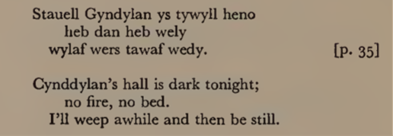
Williams does his own translations, which I always appreciate as a welcome indicator of both expertise and passion. Here is an englyn from the late-antiquity chapter that Williams adores and I am equally fond of:
I am so excited about this book that I made this entire page to talk about it somewhere. I haven't finished it yet. I will surely have more to say when I do.
Where Can One Read It?
I can provide a handly little Internet Archive copy of the book, which anyone with a free account can check out and read. This is not where I got a copy of this book, but I am reluctant to share where I got a copy of this book.
Other Excerpts from this Book
Oh my God I love it so Much


Return to Navigation
Proto-Indo-European Trees by Paul Friedrich
What is It?
A study of the words for 20-ish common Eurasian trees in assorted PIE descendants intended to propose the original PIE words.
Why do I Love It?
I don’t recall how or why I ran across this book. Likely it came from a term search of ‘proto-indo-european’ that went well. If you haven’t been to this rodeo often, PIE is the theoretical historical root language of the entire interrelated family tree of indo-european languages. Studies of the language at the entry level tend to be focused on words that have obvious relationship across geographically disperse European and Asiatic languages; if a similarity in sound can be found between a words that mean the same thing in Urdu, Tochrian, Ancient Persian, Old High German, Gothic, and Middle Welsh, you’re in business to start identifying a PIE root word.
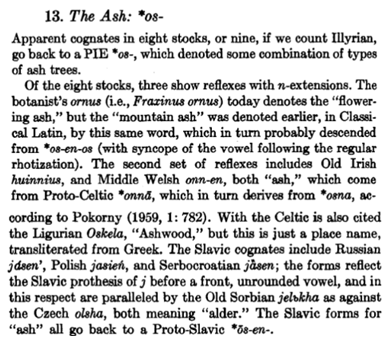
This book is specifically hunting for the names of common trees in the PIE language. Friedrich targets twenty-or-so (some species/genus classification changes over time makes the number blurry, as with ‘cedars’ and ‘junipers’ sometimes being the same thing in some languages) trees common to what we believe was the PIE heartland thousands of years in the past in the early Holocene and looks for what their common names might have been based on both current words and paleobotanical evidence.
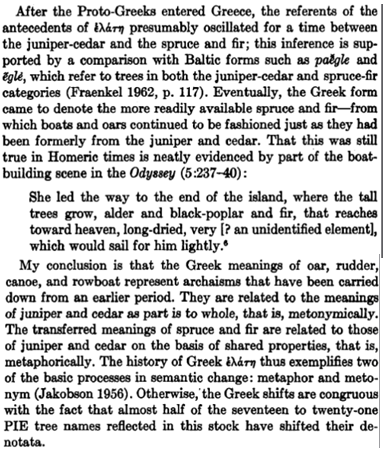
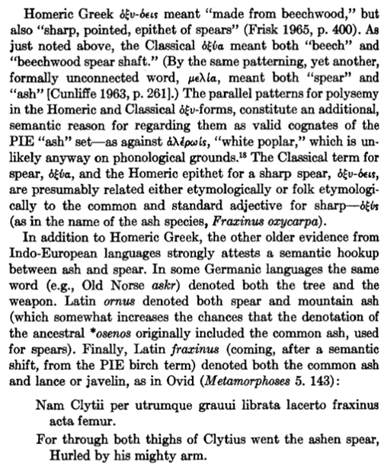
If one looks at a modern dictionary of PIE root terms today, some of his conclusions are adopted as fact and some of them are still questioned. Still reading through this book greatly expanded my knowledge of… well… common trees, many of which I could not readily identify before, and led me to a treasure trove of folklore and common mythology; just the entry for ‘ash’, ‘os’, taught me that the words for ‘ash tree’ and ‘spear’ were synonymous in many historical languages as only ask was used to make spears, made me realize that a favorite folk song of mine is actually Welsh in origin, and gave me a new appreciation for the depth of tree-lore found in a single passage in the Odyssey.
It’s a niche topic but a very enjoyable one. The main reason I love this book is that it is just chock full of interesting little facts I might have never ran into on my own.
Where Can One Read It?
I am, as oft I am, reluctant to say where I found a copy of this book myself. One can, as with many examples above, borrow a copy online through the Internet Archive.
I want to take a moment just to show you also the ‘selected works’ section of Friedrich’s Wikipedia page. Behold a guy who had things to say.
Return to Navigation
Home Girls

What Is It?
An utterly killer collection of nonfiction essays, personal memoir, short stories, and poetry written by queer women of color in the early 1980s.
A Little More Background
Back in the day, especially in the 1970s and 1980s, there was a movement of small feminist publishing houses opening up to specifically publish women’s writing (many of which lasted only a few years), and an accompanying subcultural movement of lesbian publishers. (These things do exist today, but this early movement was a trailblazing one.) Naiad Press comes to mind as a significant name— I have a few Naiad Press publications and might be adding them to this page eventually— and the Daughters of Bilitis.
Another was Persephone Press, a small lesbian publishing house that did not last long. It gathered under its wings quite a few non-white lesbian writers, which was especially rare, and in the early 80s they started gathering short stories, memories, and poems from these POC queer women with the intent to write an anthology.
Editor Barbara Smith was informed when the project was well under way that Persephone Press was bankrupt and folding, and would not be able to publish the book. (The last book Persephone Press did publish, by the way, is Audre Lorde’s memoir Zami: A New Spelling of My Name, a book that is itself well worth reading.) In response, Smith and some of the other contributors made their own publishing house, Kitchen Table Press, and published that book by themselves. That book is Home Girls, a collection of small reads that are still, forty years later, utterly face-scorching.
Both 'Kitchen Table', by the way, and 'Home Girls', were chosen partially to indicate these authors' strident assertion that as black queer women, they deserve a placein the home. That is, they do not deserve to be cast out; they have every right to sit at the table with their families in pleace.

Why do I Love It?
It’s really good.
Anthologies can be a little hard to sell to a potential reader. They are necessarily vaudeville, a constantly re-starting show featuring dozens of performers. Of course quality varies a little, but overall, quality is very high in Home Girls. I found this book by way of Lorde, but it introduced me to several authors whose independent work I went on to explore (like Barbara Smith, Michelle Cliff, and Ama Ata Aidoo), and all of those works were very good too.
Kitchen Table Press was a group of women furious with the present and aggressively envisioning a better future. We still do not have that future today. This book will make you equally angry and hopeful and, if you choose hope, spur you forward.
And there’s lesbian sex!

Where Can One Read This?
1983 is stretching the limits of what I really should include on this list. Though published by an ultra-rare, homemade, niche publisher, Home Girls has since been acquired by Rutgers, which is selling 40th Anniversary copies. That’s… not exactly out of print, though in my defense, I started this entry under the impression it genuinely was out of print. I think its relative obscurity in the mainstream means I’m still within bounds (even if I’m flirting with the line.)
That said, the original Kitchen Press edition sure isn’t being printed anymore, and I have heard on the wind that intrepid internet searchers have seen that edition around.

Return to Navigation
Online Libraries
Places to find the rare, the strange, and the out-of-touch online. I am excluding any single-author archives and most single-subject archives from this list—or perhaps I'll make an 'oddly specific' section to add to the end of this list some day.
The Big Three
- The Internet Archive: The immortal, unconquerable Archive hosts both the Wayback Machine, a record of internet pages of ages past, and the Archive itself, with millenia of stored human knowledge and creative work.
- Project Gutenberg: PG is an ancient spirit of Good on this internet. Free books, forever. Have fun.
- Librivox: Librivox uses a team of volunteers to record free audiobooks in the public domain. It has a fine selection of both pre-modern works and niche modern works.
Delightful Personal Websites
- An Eclectic Library: Fantastic curated collection of pre-modern and early modern books, sorted by subject. Most of their links take you to the Internet Archive, but there is something to be said for a good curation that leads you to books you otherwise would have never found.
- Elfinspell: Beautifully garish personal website with enchanting collection of out-of-print books, poems, and legends. The site is organized as a 'Court of Muses'; all of the literature it hosts is placed in the shrine of whichever Muse inspires its content.
- Telelib: Lovely medium-size online library with a great collection of out-of-print books. If you're looking for lesser-known books from the last three centuries, including authors new to you and other works by well-known authors, this site is a treasure trove.
- Holy Books: A large, varied collection of books about religion or esoterica. They have a very wide-ranging collection; I originally found it because I was looking to reread some of Herman Hesse's works.
- The Dunyazid Digital Library: A smaller curated collection of public domain books. Not as large as many of the pages on this list, but a lovely collection.
More Professional Websites
—
Return to Navigation