Why?
Note: on this page, all example images link to a website where you can get information about the image.
By far my worst subject in school was foreign language. I was a good student overall and I was espcially gifted in my domestic language courses. I suspect, now, that my hang-ups were largely social; I froze up when trying to convey my solid understanding of grammar into coherent conversation, I failed to pronounce what I could easily read, I stammered my way through oral exams as untreated anxiety destroyed my chances of actually focusing on the words I was saying.
For reasons lost to both time and me, I elected to take a full year of Ancient Greek in my last year of my undergrad while severely mentally ill and burnt out. I fucking smoked it. In a class in which three-quarters of the intial learners dropped out in the first semester, I was the blooded but unbowed King of Ancient Greek at the end of the third and final semester. My professor asked me why I stormed his class and outpaced all the seminary students and classicists when I was a mere English major, and I had no answers for him. I left him devestated and continued to have no use at all for ancient Greek in my daily life.
It turns out, if language-learning is the clinical, solitary autopsy of a long-dead language, rather than induction into a vibrant, living tradition, I'm great at it.
My passion for dead languages began with Ancient Greek but has lead me to many other scripts, none of which I can speak or read convincingly, most of which I have only dabbled in. It is a passion, not a discipline.
This page will mostly function as a collection of links and commentary; I rarely generate any content when it comes to language-learning, other than multiples filled notebooks of grammatical charts and vocabulary lists. Still, I highly encourage others to get into the art of learning long-dead languages; it leads one to so much knowledge about our past, our cultures, our minds, and the human race through time.
If you do this, you will get approximately two (2) chances in your life to show off your knowledge of dead languages. Use them well.
Ancient Greek
Gnothi Seautes.
As stated above, my love for Ancient Greek was what first sparked my passion for dead languages. Like many languages on this list, any form of Ancient Greek has modern, living descendants, but there are past versions of the language no longer in active use.
There are quite a few deceased Greeks that are still studied; Homeric Greek in the Iliad and the Homeric Hymns, Attic Greek in Aristotle and Aristophanes, Koine Greek in the Christian Bible, and many more. Unlike some languages on this list, we have a wealth of preserved original texts and many resources for any version of Ancient Greek you can think of, unless you dip you toes into the very origin of the language. I personally studied Attic and there are significant differences between dialects (we're talking about people using these languages across hundreds of miles and hundreds of years), but there are singificant similarities too.
The quote at the top of this section, Gnothi Seauton, is a religious phrase most strongly associated with dread Lord Apollon and his oracular temple in Delphi, upon which it was carved. It means 'know thyself.' I insist, however, on reproducing it as Gnothi Seautes. To explain quickly and loosely, all versions of Greek have grammatic gender. 'On' is a masculine ending. 'Es' is a feminine ending. 'Gnothi Seauton' would be an instruction given to a man, 'Gnothi Seautes' for a woman. I am a hater of grammatic gender, for reasons like imagining approaching a temple, a house of your God, and seeing on the words carved above the front door that it's not really meant for you.
Then again, it wasn't inappropriate to warn a human woman entering Dread Lord Apollon's temple that she might not love her welcome there.
Resources
Attic is the only language on this list that I learned in an actual classroom setting. We used From Alpha to Omega: A Beginning Course in Classical Greek. I learned later that this made us one of the very rare classroom settings that is therenore not using the Mastronarde, which has been the standard text for ages.
From Alpha to Omega did well for me, so I didn't go poking around for online sources the same as I have done for some of these other languages. My best online reccomendation is the University of Texas at Austin Linguistics Research Cetner coming in clutch yet again with another online course for a dead language.

Return to Navigation
Elamite
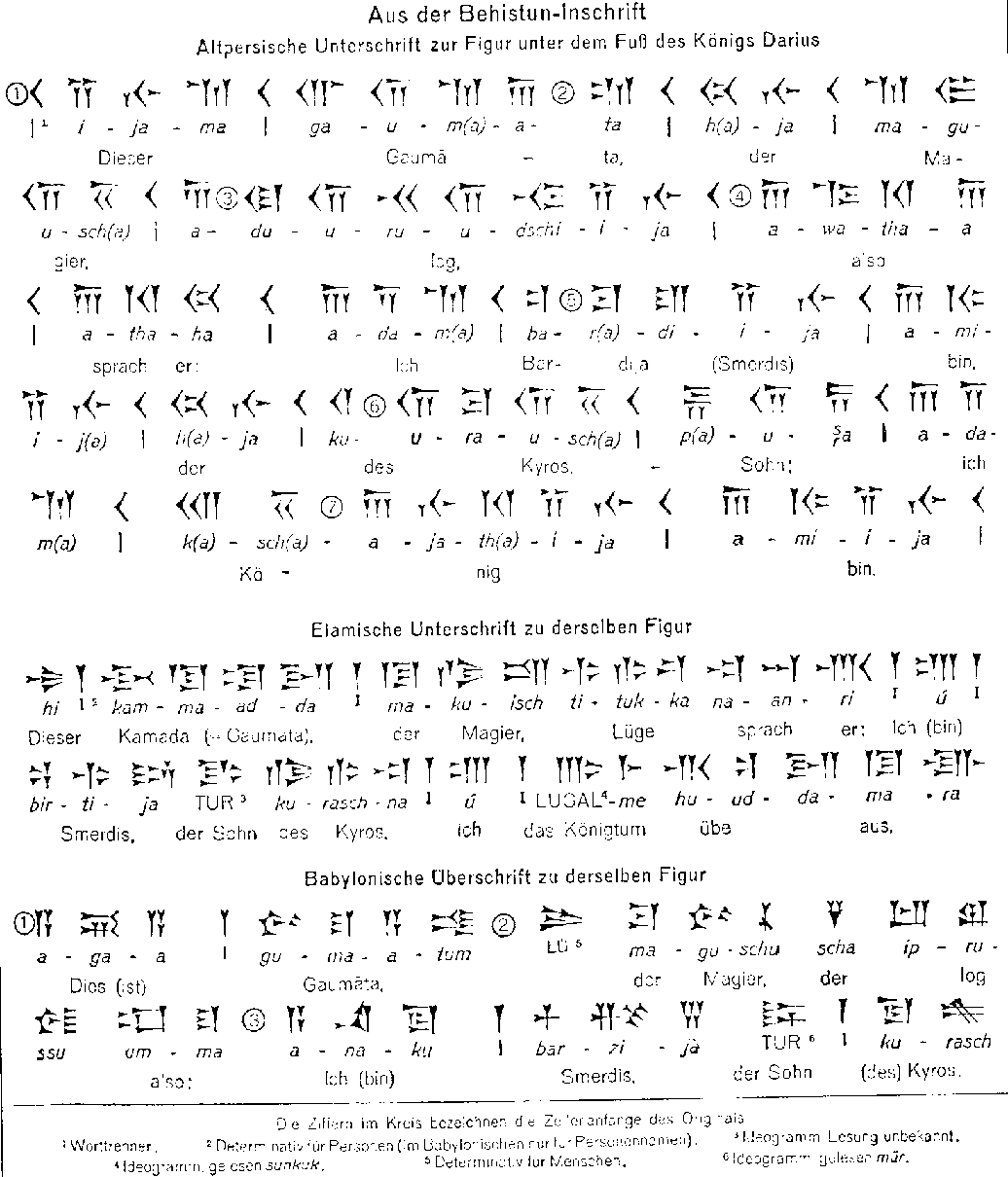
Appa?
I have to be honest with y'all. I haven't really studied Elamite. I just want y'all to know that I could. And you can. We all could.
Elamite was the tongue of the long-gone ancient kingdom of Elam. (That's the kind of imaginative naming scheme you get when archaeologists name things for you.) Like most ancient dead languages, it is also an language isolate. A language isolate is any language that has no known relatives; since no human language was gifted by God or plucked from the magical word-tree, and all of the actually came from slow linguistic drift, that really just means that all its relatives are dead.
Well, so is Elamite, but we still have its corpse, and we haven't found any corpses of its dead relatives yet.
I have a certain fascination with Elam that came initially from watching Cy's work but hasn't ended there. So far, I've only dabbled in understanding Elam, but I know myself. In two to three years I'm going to get very deep into this super dead civilization.
But the language. I am here today to provide you with a a full grammar of the Elamite language, or as full as we can get, as the extant corpus is so scant.
I love that this exists. I like knowing that, if someone wanted to, they could pick up the tools of vocabulary and grammar and syntax that three-thousand-year-old tablets have left us with and write completely new verses about birds, goddesses, kings and houses and temples, about baking bread and feeding their children, an act of linguistic necromancy that feels almost like a miracle in its improbability and grace.
Explore the Internet Archive and you can find similar works about many long-dead scripts. The world is yours.
For more general knowledge of Elam, the out-of-date but still-online website of scholar Gian Pietro Basello is both fun and a geat place to start; searching for more of his work led me to The Elamite World, an absolute 900-page Beast of a Routledge that lists Basello among its many contributors. I do not link to it because, while it's very easy to find a .pdf of the whole book, I can't find the front pages that those ghost links theoretically circle back to. That said, you can probably find it if intereested.
Return to Navigation
Middle Welsh
Dioer, Arglywdd.
A few years back, I developed and indulged an obsession with the collection of medieval Welsh tales today called the Mabinogion. I am specifically entranced by the first four tales, a connected retelling of Welsh folklore grounded in its time and place called the Four Branches. Reading and re-reading the Four Branches and obsessing over Parker's notes on his translations eventually led me to just learning Middle Welsh. You know. As one does.
Middle Welsh has many similarities to its modern counterpart, but they are not interchangable. Like all medieval languages, Middle Welsh was not standardized and varied wildly in pronounciation, spelling, and grammar across the centuries and the country. When learning, if you appear to find a 'contradiction', it is more safe to assume you have located something that naturally varied over time and place.
In the midst of learning Middle Welsh, I became obsessed with Welsh folk group Plethyn. I think they're really good.
Resources
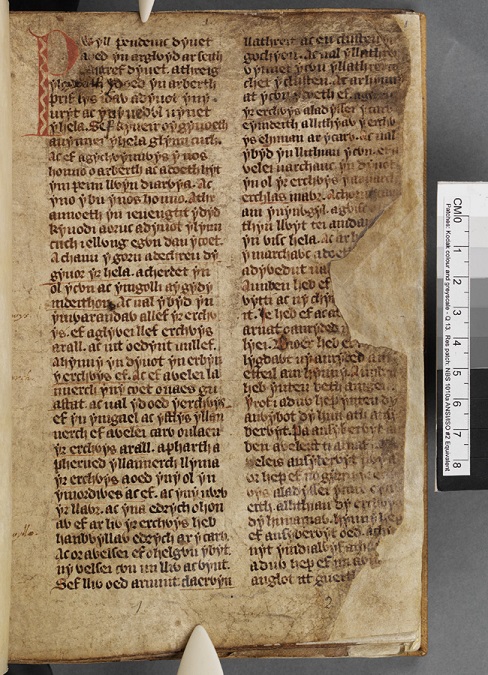
- I'm not sure how to link to it, but there's a publication by Brent Miles titled "An Introduction to Middle Welsh: A Learner's Grammar of the Medieval Language and Reader" that if you search for it you can find as what I call a 'jumpscare download'. I cannot find a landing page to link to. It is a solid, fully comprehensive, all-in-one 600-page course on the language. If you want something resembling a normal self-study, this is the thing you want.
- The most comphrensive work I have found on Middle Welsh is A Grammar of Middle Welsh by D. Simon Evans. It is a traditional grammar, covering Middle Welsh class by class and in exacting detail, but as grammars go it is an easy read. Evans makes his points plainly and packs in interesting details around the rules.
- I did not find a searchable Middle Welsh dictionary, so I am using a modern Welsh dictionary to search terms, compare spelling, and check for accuracy. The medieval vocabulary can be shockingly similar to the modern vocabulary in Welsh.
- To hear the language being read and correct your pronunciation and emphasis, here is a lovely recording of Branwen Uerch Lyrr read aloud.
- I am a big fan of Memrise' Community Courses; since users can create them, there are a lot of courses for constructed or dead languages. However, that also means quality varies. This honestly brutal Middle Welsh Grammar course is by far the best out of what exists right now. The format suggests you can blaze through this, but this course is thorough and difficult; I suggest you take your time and write out charts for memorization.
- This odd and somewhat patchy course by Gareth Morgan was the first resource I found, and I followed it for a while. It is good, and it has a much more learner-friendly format than anything else I linked, but it feels like it's missing lessons, honestly. There are so many points this course acted like it had already taught me something that it had not, ha ha. Still, that vintage web design alone is worth a bookmark.
- I will also take the opportunity to link a fantastic online reproduction of Preiddeu Annwn, a Middle Welsh poem known for being one of the first recorded mentions of King Arthur but rich in other cultural and linguistic knowledge. I have a deep personal fondness for Preiddeu Annwn; when I read it as a young woman, it became one of the first compelling mysteries that slowly pulled me into my obsession with the Middle Ages. (The reason I read Preiddeu Annwn, by the way, was because it was quoted in a Revolutionary Girl Utena fanfiction.)
If Middle Welsh ever just becomes too accessible for you, I reccomend you fall into the Cumbric rabbithole. Have fun!
Return to Navigation
Old English
Hwær cwom mearg? Hær cwom mago?
Eventually, if you Tolkien too hard, you find yourself deep in a course on Old English and asking yourself what's actually real in this world.
The study of Old English (previously known as Anglo-Saxon, a term now agreed to be so narrow it is incorrect) naturally comes with many resources available in modern English, making them easy to find on the modern internet, as it and much of the world aroudn us are bound in her imperial shackles. That does mean I can provide a stellar reference-list if I can get everything together.
My favorite long-dead OE word is adleg. It means 'flame of the funeral pyre', that is, the flame that rises from the funeral pyre sepcifically, implying it is of another nature than other fires. The word-parts are ad, pyre, and leg/lieg, flame, making it a very simple but very evocative little word.
Resources
- A fine staring point is this whole OE course presented by the University of Austin. It's honestly solid. Since it's a pared-down course it expects you to have the patience to break away from the lesson and memorize on your own, but that's just part of the study of dead languages.
- For something more comprehensive, behold a fully online OE textbook by M. D. C. Drout. Now that's the stuff.
- For a proper dictionary, I reccomend EOW, a visually bare-bones but incredibly functional modern-old English dictionary. For something that looks less... Web 1.0, try the equally good Bosworth-Toller.
- The Historical Thesaurus, more a tool for fun than a tool for seriously learning OE, is nonetheless really, really fun. Put in any English word and it will have you choose a semantic category; pick that category and it will provide you a list of words both modern and archaic, meaning approximately the same thing, ordered by the centuries in which they were in use.
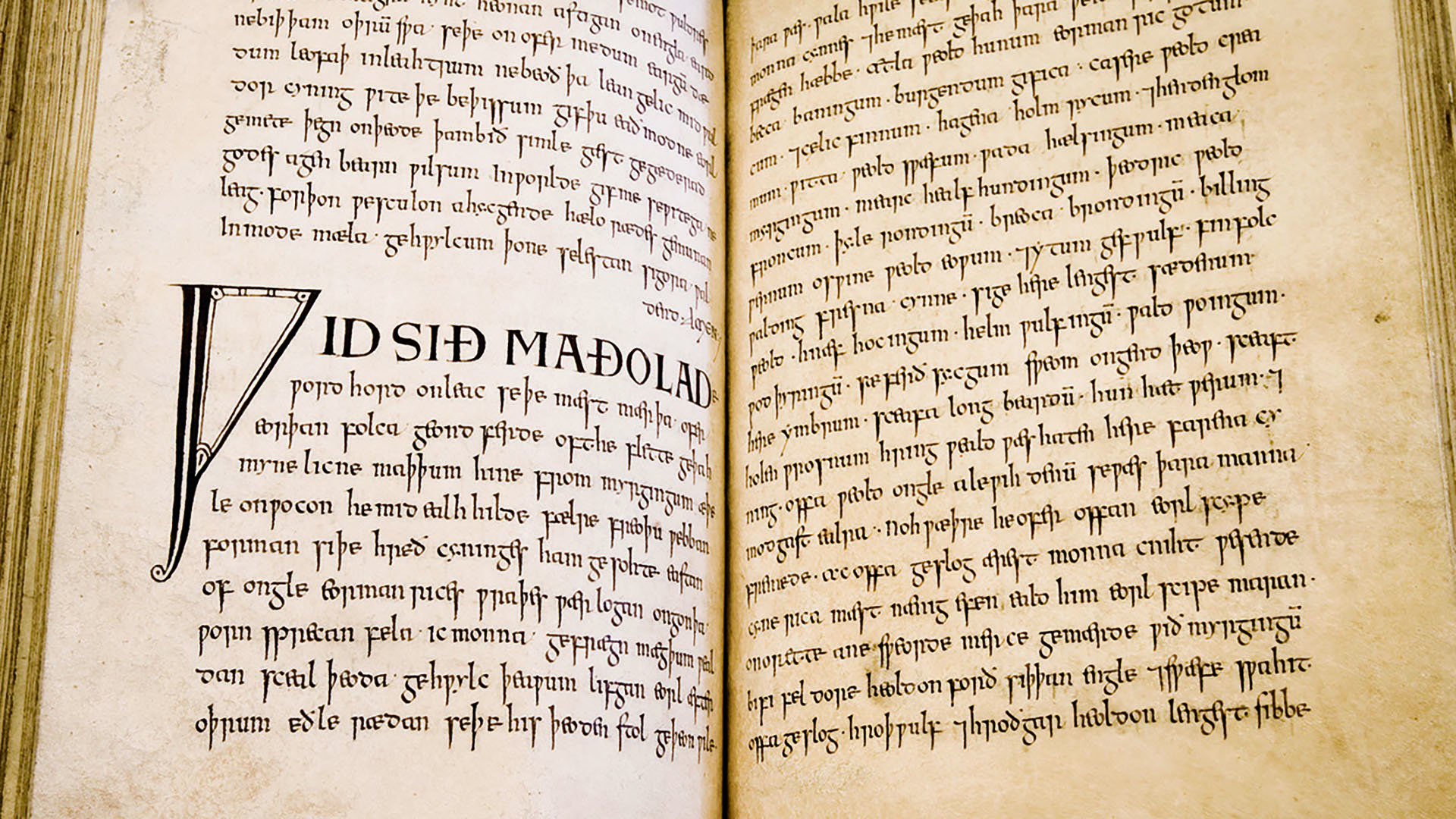
- For some original OE text that isn't just another edition of Beowulf, I reccomend the hypertext online Battle of Maldon. I was initially introduced to Maldon by James Reston Jr.'s The Last Apocalypse, an excellent history of Europe in the year 1000 CE. This website is just a classic old website, incredibly readable, packed with extra information and context, including delightful hand-drawn maps. I love some vintage internet.
- Potentially my favorite of the OE texts, though, is The Wanderer; this is not just for the Tolkien connection, which I did not know about when I first read the poem (though I stumbled across those lines with a feeling like finding gold in a river). It is the searing depiction of soul-deep lonliness that reaches to me across the ages, an account of life on thousand years ago that feels as if it is sitting beside me.
- One book I cannot reccomend enough is Hana Videen's Wordhord. It is not a book intended to teach you the language but a book that intends to teach you about the world and culture in which the language was spoken. Each chapter covers a semantic topic and discusses relevant and unsual OE words related to that topic in order to pick at the strings of culture tied into their uses and meanings. I get dizzy even thinking of her discussion of the word beobred. And, by the way, Videen will gladly blast one OE word into your inbox each day if you'd like her to.
Return to Navigation